
If you're still parking your future in a traditional savings account, are you actually building wealth or just watching it slowly dissolve? While national average interest rates sit at a dismal 0.22 percent, inflation and 18.59 trillion dollars in national household debt are actively rigged against your stagnant capital. You feel the pressure of a plateauing income and the exhaustion of trading hours for dollars. It's a game where the rules have changed, and without sophisticated wealth building systems, you're essentially playing with a broken controller.
You deserve a strategy that scales as fast as the modern market. This article breaks down the exact methodology required to stop the leak and start engineering scalable cashflow. We'll move past the complex jargon and look at the hard data behind business automation and diversified assets. You're about to discover a clear roadmap to financial freedom that works while you sleep, so you can finally exit the 40-year grind and start winning on your own terms.
Key Takeaways
- Abandon the myth that skipping small luxuries creates elite wealth and learn why active systematization is the only way to protect your capital.
- Master the architecture of wealth building systems by implementing the three critical pillars of acquisition, optimization, and multiplication.
- Discover why linear income is a high-stakes trap and how to transition to a model where your financial output isn't tied to your physical hours.
- Perform a surgical audit of your daily schedule to separate low-value tasks from the high-value activities that actually drive scalable growth.
- Stop acting as a component in someone else's machine and learn why specialized, systems-first education is the ultimate shortcut to financial autonomy.
The Frugality Trap: Why Saving Money Isn’t a Wealth Building System
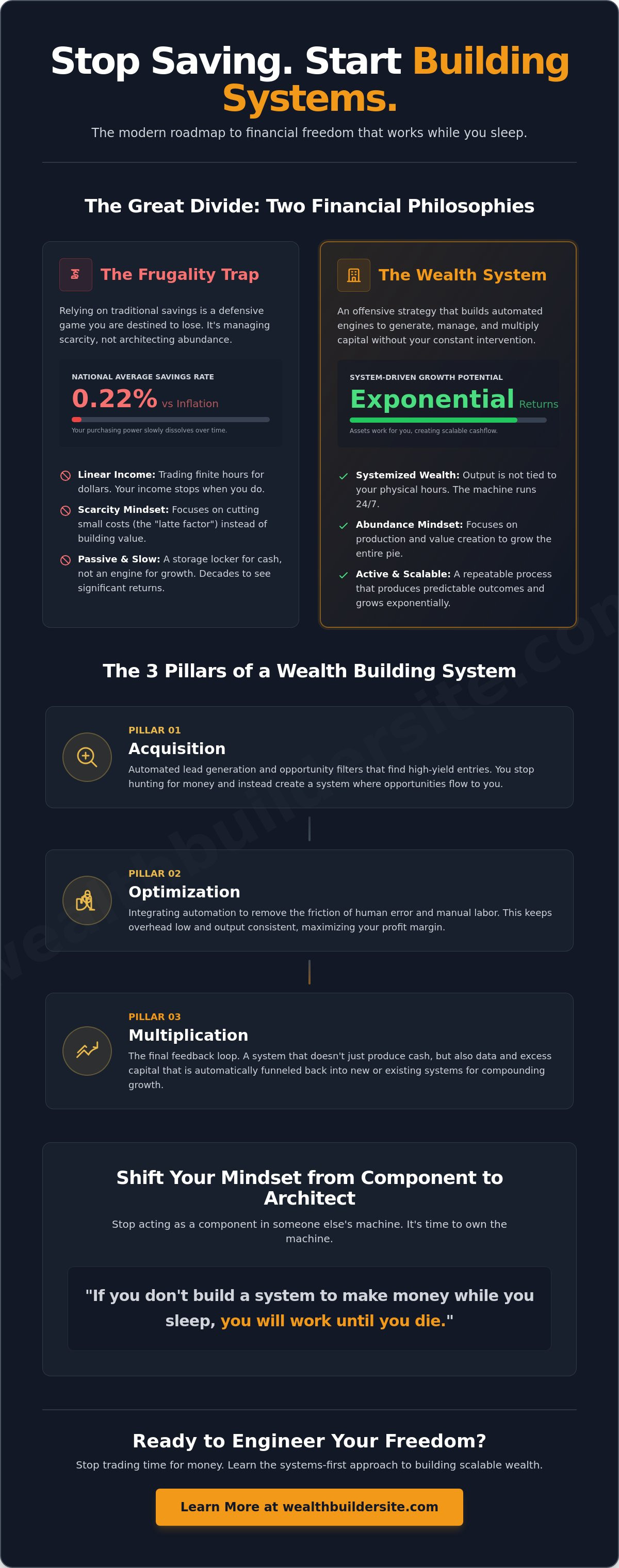
Stop pretending that your high-yield savings account is a strategy. It's a storage locker. In 2026, while top-tier accounts might offer interest rates up to 5.84 percent, the national average for traditional accounts is still stuck at a dismal 0.22 percent. If you're relying on bank interest to make you rich, you've already lost the game. Traditional saving is passive; it's the act of hiding money from yourself. Systematizing is active. It's about engineering wealth building systems that generate capital regardless of your physical presence. You aren't just looking for a place to put money. You're looking for a way to multiply it.
We've been told for decades that the "latte factor" is the key to millions. This is a lie designed for the mediocre. You don't reach elite status by cutting out a five-dollar coffee; you reach it by increasing your value and automating your income. Frugality is a defensive play. It focuses on the definition of wealth as a finite pile of cash to be guarded. True wealth is a flow, not a pile. If your focus is entirely on what you spend rather than what you build, you're suffering from financial stagnation. You're managing scarcity instead of architecting abundance.
The Math of the Slow Lane
If you save 10 percent of a 100,000 dollar salary, it will take you decades to see seven figures, even with compound interest. By then, 2026 inflation levels will have eroded your purchasing power to a fraction of what it is today. You're running a race on a treadmill that's moving backward. Traditional advice obsesses over the time-value of money, asking you to wait 40 years for a payout. We focus on the time-value of systems. A well-built system can accomplish in three years what a savings account can't do in thirty. A wealth system is a repeatable, scalable process that produces a predictable financial outcome.
Defense vs. Offense in Your Portfolio
Most financial advice is 90 percent defensive. It's about "not losing." But you can't win a championship if you never leave your own end of the field. You need an offensive strategy. This requires a shift from being a "budgeter" who manages scarcity to an "architect" who designs wealth building systems. If your only tool is a savings account, you're just a component in someone else's machine. It's time to own the machine. Shift your mindset from protection to production. If you don't build a system to make money while you sleep, you'll work until you die. It's that simple.
Decoding the Architecture: What Actually Constitutes a Wealth Building System?
If you stop working, does the money stop? If the answer is yes, you don't have a business; you have a high-stress job with better tax deductions. Most professionals mistake a collection of assets for a strategy. They own a rental property or a few stocks and call it a day. But an asset is just a component. True wealth building systems are the engines that acquire, manage, and grow those components without your constant intervention. A system is a rigorous architecture of "if/then" procedures. If a specific market condition is met, the system triggers an acquisition. If a profit threshold is reached, the system triggers a reinvestment. It's a permanent asset that functions independently of your pulse.
The Three Pillars of Systemic Wealth
Acquisition is the first pillar. Most people spend their lives hunting for money. A systemized approach flips the script. It uses automated lead generation and opportunity filters to find high-yield entries while you focus on higher-level strategy. It's about moving from a predator in the wild to a farmer with an automated irrigation system. You aren't looking for a paycheck; you're looking for an entry point into a repeatable cycle.
Optimization is where the real margin is won. By integrating business automation software, you remove the friction of human error and manual labor. If you're still manually checking spreadsheets or chasing invoices, you're burning capital. Systems ensure that your overhead stays low while your output remains consistent. This isn't about being tech-savvy. It's about being profit-obsessed and refusing to do work that a machine can do better.
Multiplication is the final feedback loop. A system doesn't just produce cash; it produces data and excess capital that is automatically funneled back into the next machine. This creates a compounding effect that moves faster than any traditional savings account ever could. You aren't just saving; you're building a fleet of income-generating soldiers that work 24/7 without a vacation.
Software vs. Strategy: Don’t Buy the Tool Before the Blueprint
One of the most expensive mistakes you can make is buying the tool before you have the blueprint. Entrepreneurs often purchase expensive CRM software without having a defined sales process. That's like buying a Ferrari engine for a bicycle. It's heavy, expensive, and completely useless. You must follow the "System-First" rule: design the workflow on paper before you touch a single piece of software. If you can't describe your process in a simple flowchart, you don't have a process. You have chaos.
Most business owners are the primary bottleneck in their own wealth building systems. They want to be the hero who solves every problem, but heroes don't scale. If every decision requires your approval, you haven't built a system; you've built a cage. You can learn to break that cycle and map your first scalable workflow at a Business Systems & Solutions Workshop. Stop being the component and start being the architect of your own freedom.
Linear Income vs. Systemized Wealth: The Math Competitors Won’t Show You
How much is an hour of your life actually worth? If you're stuck in a linear income model, your value is permanently capped by the clock. Linear income is a simple, brutal equation: your time equals your money. If you stop, the money stops. This creates the "Ceiling Problem." You can only work so many hours before you hit a physical and mental limit. Traditional financial advisors tell you to grind for a promotion or a 3 percent raise, but that's just a slightly more comfortable version of the same trap. You're still the only engine in the car. If you break down, the car stops moving. It's a high-stakes gamble where you are the only point of failure.
Contrast this with the logic of wealth building systems. A system is an asset that works when you don't. It doesn't need sleep, it doesn't get burned out, and it doesn't ask for a raise. While your competitors are busy "hustling" to increase their hourly rate, you should be focused on scalability. Scalability means your output isn't tied to your input. A well-engineered system can handle 10 times the volume of a manual process with only a 20 percent increase in oversight. You aren't working harder; you're just using better leverage. In the competitive environment of 2026, the person with the best infrastructure wins, not the person who works the most hours.
The Scalability Audit
Is your current income stream a scalable asset or just a high-paying chore? Apply the "One-Week Test." If you turned off your phone and disappeared for seven days, would your business collapse? If the answer is yes, you're the bottleneck. You need to stop being a component and start being an owner. You can find the blueprint for this transition by learning how to build an online business passive income engine. If your income depends on your presence, you don't own a business; the business owns you. True freedom requires a machine that doesn't need your pulse to stay profitable.
The Compound Effect of Automation
Hustle culture is a lie sold to those who haven't mastered leverage. Real growth comes from the compound effect of saved time. If you automate just five hours of manual tasks per week, you reclaim 260 hours every year. That's over six full work weeks returned to your life. Use cashflow management tools to identify where your capital and time are being wasted on manual labor. Efficiency isn't just about saving money; it's about buying back your freedom. If you don't systematize, you're just a highly-paid slave to your own ambition. Don't be the hardest worker in the room. Be the one who owns the room's infrastructure.
From Chaos to Cashflow: How to Audit Your Life for Systemic Gaps
Are you actually building an empire, or are you just busy? Most professionals mistake movement for progress. They spend their days reacting to fires instead of building the systems that prevent them. If your daily schedule is a chaotic list of "to-dos" rather than a set of "if/then" triggers, you're leaking capital every single hour. To transition into elite wealth building systems, you must first perform a surgical audit of your current operations. You can't optimize what you haven't measured. If you don't know where your time is being stolen, you can't buy it back.
The HVA/LVT Matrix
Every task you perform has a price tag, but not all tasks pay the same. Low-Value Tasks (LVTs) are the administrative anchors that keep you grounded. These are the 10 dollar an hour chores; checking emails, manual data entry, or chasing minor invoices. High-Value Activities (HVAs) are the 1,000 dollar an hour moves; strategic networking, closing major deals, or designing new income engines. Why are you still doing the work of an assistant? If you want to scale, you must apply the "Delegate, Automate, or Eliminate" framework. If a machine can do it, automate it. If a lower-cost resource can handle it, delegate it. If it doesn't move the needle on your wealth building systems, eliminate it entirely. Many entrepreneurs struggle to let go because they mistake control for security. In reality, your need for control is the primary barrier to your freedom.
Mapping Your Wealth Engine
Visualize your income as a complex plumbing system. Where are the leaks? Where is the pressure dropping? Most people have a single pipe, usually a job, that is prone to bursting at any moment. A systemized wealth engine has multiple, automated inflows that don't require your manual labor to stay pressurized. You must identify the psychological blocks that keep you tethered to manual work. Many high-achievers suffer from a "hustle" addiction where they feel guilty if they aren't exhausted at the end of the day. You can break this self-sabotaging cycle by mastering the principles of Money Mastery. Once you identify the mental bottlenecks, you can set your first systemic goal. Replace one manual task with an automated workflow this week. Reinvest that "time profit" into learning how to engineer higher-level assets. If you're ready to stop guessing and start building, join us at the next WealthBuilders Conference to see these frameworks in action.
Engineering Your Freedom: Why Systems-First Education is the Only Shortcut
If you're still following the syllabus of the 20th century, you're preparing for a world that no longer exists. Traditional education is designed to produce high-functioning cogs. It trains you to be a component inside someone else’s wealth building systems, but it never teaches you how to build your own. You spent years learning how to be a "good employee" or a "skilled professional," which is essentially a masterclass in trading your life for a paycheck. If you want to break the cycle, you need to unlearn the habit of manual labor and start learning the mechanics of business automation. Specialized mentorship isn't a luxury; it's the only tactical shortcut to bypass the decades of trial and error that swallow most ambitious professionals whole.
The Biblical Blueprint for Systems
Wealth isn't just about personal accumulation; it's about strategic stewardship. In the framework of God’s Road to Financial Freedom, we see that resources are meant to be multiplied, not just hoarded. Consider the "Unfaithful Steward" who buried his talent in the ground. He was the original "saver." He chose the perceived safety of a hole in the dirt over the growth of a system, and he was condemned for it. Don't make the same mistake with your capital. Systematizing your finances allows you to make impact a predictable output rather than a sporadic impulse. If your generosity is manual, it's limited by your current cash on hand. If it's systemic, it's fueled by a machine that grows regardless of your physical presence.
Your Next Tactical Move
Waiting for the "perfect time" is a systemic failure. In a 2026 economy where 95 percent of wealth management firms are already integrating AI, hesitation is a cost you can't afford. You're either the architect of a system or a component within one. There is no middle ground. You need a community of system-builders who have already decoded the market complexities that keep most people paralyzed. You need the definitive blueprint provided by WealthBuilders University. This isn't just another course; it's the high-stakes training ground for your autonomy. Stop guessing. Start engineering. Your freedom won't happen by accident. Take command of your future and join the WealthBuilders University program today.
Exit the Slow Lane: Architect Your Financial Independence
The data doesn't lie. Parking your capital in a 0.22 percent savings account isn't "playing it safe"; it's a slow-motion surrender to inflation and systemic stagnation. You've seen that linear income is a physical trap that caps your value at the clock. True freedom requires a shift from being a manual worker to becoming a strategic architect. By auditing your life for systemic gaps and replacing manual labor with automated workflows, you've already begun the transition from a component to an owner.
Now you face a choice. Will you continue to grind out a living, or will you engineer a legacy? Implementing sophisticated wealth building systems requires precision and proven frameworks that the traditional education system never taught you. You need more than just a mindset; you need the mechanics of business automation and the guidance of those who have already decoded the market.
Get the proven frameworks for business automation and direct mentorship from seasoned strategic insiders. Join a community of results-oriented entrepreneurs who refuse to settle for the status quo. Stop trading your time for money-join WealthBuilders University today. Your future is an inevitable output of the systems you build today. Go take command of your results.
Frequently Asked Questions
What is the difference between a wealth building system and a standard investment?
An investment is merely a vehicle, while a system is the engine and the driver. Standard investments like stocks or bonds are often passive bets on someone else's performance. In contrast, wealth building systems are proactive architectures you own and control. They use specific "if/then" triggers to automate how you acquire, optimize, and multiply capital. If you're just buying an asset, you're a passenger. If you build a system, you're the architect.
Do I need to be a tech expert to use business automation for wealth building?
You don't need to write code to build a financial empire. You need to be a strategist who understands workflows, not a technician who understands syntax. Modern automation tools are designed for high-level architects who can map a process on paper. If you can define a repeatable sequence of tasks, you can use software to execute them. The goal is to spend your time on strategy while the machine handles the labor.
How much capital is required to start a wealth building system in 2026?
The amount of capital required depends entirely on the specific engine you choose to engineer. Some systems focus on leveraging existing intellectual property with minimal overhead, while others, like those covered in a Real Estate Workshop, require more significant entry liquidity. The focus shouldn't be on the cost, but on the return on systems. You're buying an asset that produces time, which is the most valuable currency you have.
Can wealth building systems work for someone with a full-time job?
Systems are actually the only way for a full-time professional to escape the time-for-money trap. If you have a career, you have the seed capital to fund your first wealth building systems. You use your linear income to build automated engines that eventually outpace your salary. The system works while you are at your desk, creating a parallel income stream that doesn't require a second 40-hour work week.
What are the most common myths about "passive income" systems?
The most dangerous myth is that passive income requires zero effort. Real systemic wealth is the result of heavy active lifting during the architecture phase. You don't just "set it and forget it"; you design, test, and optimize until the machine is reliable. If someone promises you elite wealth without a rigorous build phase, they're selling you a fantasy. True freedom is earned through the precision of your initial engineering.
How do biblical principles fit into modern wealth building systems?
Biblical stewardship is the original framework for multiplication. The Parable of the Talents makes it clear that we're expected to grow what we've been given, not just store it in a hole. Modern systems are simply the tactical tools we use to fulfill this ancient mandate. When you build a system, you're creating a predictable engine for generosity and impact. Wealth is a tool for service, not just a scoreboard for ego.
How long does it typically take to see results from a new system?
You'll often see "time profits" within the first week of automating a low-value task. Financial results follow once the system reaches a critical mass of optimization. This isn't a get-rich-quick scheme; it's an engineering project. If you follow proven frameworks, you can bypass the decades of trial and error that swallow most investors. Speed is a byproduct of precision. Focus on the blueprint, and the results will take care of themselves.
Is real estate considered a system or just an asset?
Real estate is a raw asset that only becomes a system when you apply a management and acquisition framework to it. If you're the one fixing toilets and chasing rent, you've just bought yourself a low-paying job. To turn property into a wealth engine, you must systematize the tenant screening, maintenance, and financing. Don't just collect deeds; collect automated workflows. That's the difference between being a tired landlord and a wealthy owner.