
Can I ask you one question? Are you building a wealth-generating asset, or have you simply trapped yourself in a high-stakes job where you're the most exhausted employee? If you're still manually managing bottlenecks while your competitors use AI to scale, you aren't just falling behind; you're choosing stagnation. The global market for business automation software is projected to hit $28.4 billion this year. Yet, most entrepreneurs are still playing by old rules and trading their limited time for capped returns.
You likely feel the burnout of repetitive admin and the fear that AI-driven rivals will eventually leave you in the dust. It's a valid concern. This article, brought to you by Business Systems & Solutions, shows you how to leverage the right tools to create a business that runs itself and scales your wealth without needing more staff. We'll explore the exact platforms delivering an average ROI of 300% and provide a clear roadmap to move you into that Top 5% Rank where revenue flows even while you sleep. Stop guessing and start orchestrating your success.
Key Takeaways
- Shift your mindset from trading hours for dollars to building a digital nervous system that protects your most valuable asset: time.
- Uncover why business automation software is the only logical choice for entrepreneurs who refuse to let manual bottlenecks cap their revenue potential.
- Master the 'Stop Guessing' framework to audit your current operations and identify which tools will actually deliver measurable ROI.
- Follow a proven 30-day strategy to eliminate repetitive admin and transition from a stressed operator to a strategic insider.
- Understand the critical link between automated systems and the WealthBuilders philosophy of building a business that scales without you.
What is Business Automation Software? (And Why the Game Already Changed)
Can I ask you one question? Is your business a living organism that grows while you sleep, or is it a collection of fragile manual tasks that die the moment you stop working? If you're still clicking buttons and moving data by hand, you aren't an entrepreneur. You're a high-priced administrator. Business automation software is the digital nervous system of a modern enterprise. It's the difference between a business that owns you and a business you actually own.
The wake-up call is here. In 2026, manual processes are no longer just an "inconvenience." They are a liability. If your lead follow-up depends on your memory, you're losing money. If your client onboarding requires your physical presence, you're capped. Stop guessing about your growth and start building systems for wealth. A tool is something you use; a solution is a system that works for you. The elite 5% have already moved from "hustle" to "orchestration." Which side of that line are you on?
The Core Categories of Automation
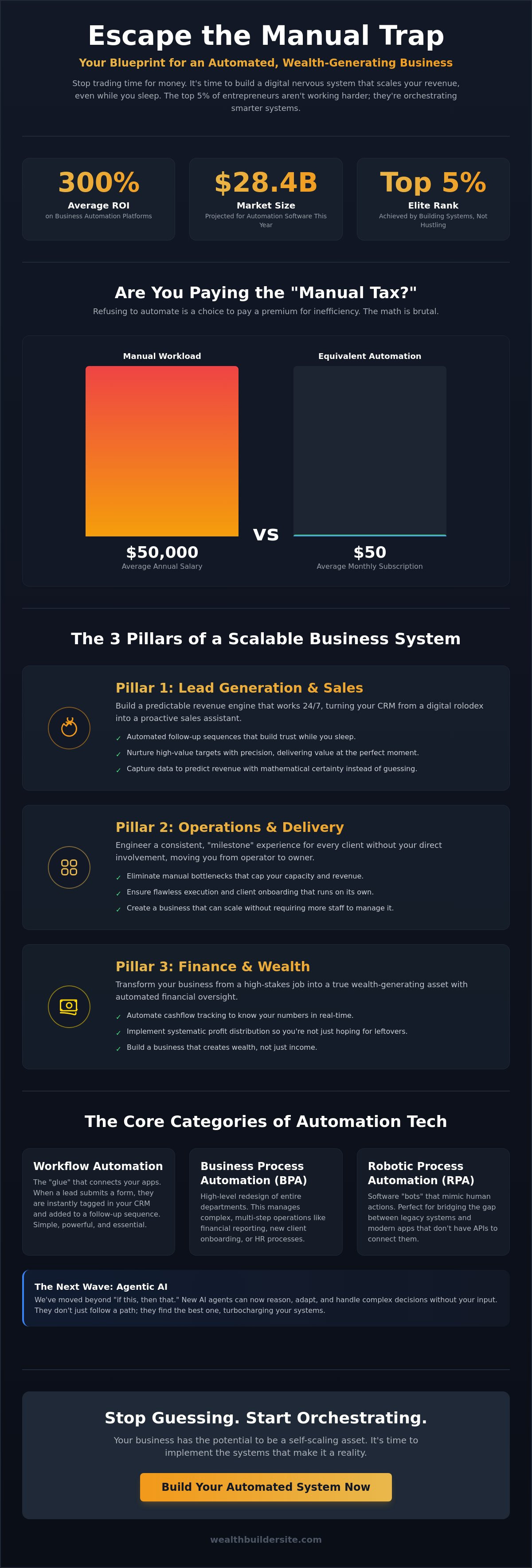
Understanding the architecture of your digital system is the first step toward freedom. Most professionals confuse simple apps with complex strategies. You need to distinguish between three specific layers:
- Workflow Automation: This is the "glue" that connects your existing apps. It ensures that when a lead hits your site, they are instantly tagged in your CRM and added to a sequence.
- Business process automation (BPA): This is the high-level redesign of entire departments. It moves beyond simple triggers to manage complex, multi-step operations like financial reporting or HR onboarding.
- Robotic Process Automation (RPA): This involves teaching software to mimic human actions. If you have legacy software that doesn't "talk" to modern apps, RPA acts as the digital hands that bridge the gap.
Why 2026 is the Year of the Automated Entrepreneur
The game changed because automation is no longer just "if this, then that." We've entered the era of Agentic AI. These aren't simple triggers; they are autonomous agents that can reason, adapt, and handle complex decisions without your input. They don't just follow a path. They find the best one.
The math is simple and brutal. A $50 per month subscription to the right business automation software can now execute the workload of a $50,000 annual salary. If you refuse to implement these systems, you're effectively paying a "manual tax" on your own wealth. The "Top 5% Rank" in any industry isn't achieved by working harder. It's achieved by building a scalable system that doesn't require more staff to generate more revenue. It's time to stop playing by old rules.
The 3 Pillars of a Scalable Business System
Most entrepreneurs think they have a business. They actually have a collection of high-stress hobbies. If you automate your marketing but your delivery remains a manual mess, you've just built a faster way to fail. A truly scalable architecture requires three symmetrical pillars. Ignore one, and the whole structure collapses under its own weight. This isn't about adding a few apps to your phone. It's about a fundamental shift in how your enterprise breathes.
The first pillar is Lead Generation. Stop guessing where your next check comes from. In 2026, the right business automation software allows you to build an engine that never sleeps. It identifies high-value targets and nurtures them with precision. The second pillar is Operations and Delivery. This ensures a consistent "Milestone" experience for every client without requiring your physical presence. Finally, the Finance and Wealth pillar automates cashflow tracking. If your profit distribution isn't automated, you're just hoping there's money left at the end of the month. If you're ready to move into the elite rank of owners, you can start by exploring the resources at WealthBuilders to audit your current systems.
Automating the Lead-to-Sale Pipeline
Your CRM should be a proactive sales assistant, not a digital Rolodex. If your software isn't telling you exactly who to call and when, it's failing you. Automated follow-up sequences build trust while you sleep by delivering value at the exact moment a prospect needs it. By integrating specific online business tools, you capture data that allows you to predict revenue with mathematical certainty. Why leave your wealth to chance when you can script your success?
Operational Efficiency: The Back Office Engine
Delivery is where your reputation is built or buried. Modern project management tools can now assign tasks based on real-time triggers, moving projects through your funnel without a single "check-in" meeting. This removes the human bottlenecks that kill growth. When you commit to a rigorous business system implementation, you gain the ability to scale without adding more staff. You stop being the "fixer" and start being the architect. Automated reporting then gives you the hard data needed to see your profit margins clearly. If you can't see the numbers, you can't protect the wealth. Use business automation software to turn your back office into a silent, high-performance engine that requires zero maintenance from you.
The "Stop Guessing" Framework: How to Evaluate Software
Can I ask you one question? Are you choosing your tech stack based on a "top ten" list you found online, or are you building a fortress for your wealth? Most entrepreneurs treat software like a toy. They buy the newest app, play with it for a week, and then wonder why their bank account hasn't moved. Stop guessing. If your business automation software doesn't integrate seamlessly with your existing stack, it isn't a solution. It's a silo. A silo creates more work, not more freedom.
You must evaluate every tool through the lens of the "Scalability Ceiling." If you're going to outgrow a platform in six months, don't install it today. The cost of switching is a wealth-killer. You also need to avoid the trap of the over-engineered solution. If a tool is too complex for your team to use without a PhD, it will become expensive "shelfware." A tool is only as good as its documentation and the community supporting it. If you can't find an answer to a problem in five minutes, that tool is a liability.
No-Code vs. Custom Code: Choosing Your Level
The game changed for the 2026 entrepreneur. You no longer need a fleet of developers to build a digital empire. Platforms like Zapier and Make have become the high-performance engines of the modern enterprise. Zapier now offers "AI Guardrails" and tiered plans starting as low as $19.99 per month for multi-step Zaps. This allows you to move fast and break bottlenecks without breaking the bank.
However, if you're operating at an elite level with legacy systems, you might need the power of enterprise-level RPA. Tools like UiPath, with developer licenses starting at $420 per month, allow you to mimic human actions on a massive scale. But remember: no-code doesn't mean no-strategy. If you automate a broken process, you just break things faster. The system must be designed before the software is purchased.
The ROI Calculation: Software as an Investment
Stop looking at software as an expense. It is a capital investment. To see the truth, you must calculate the Cost of Inaction (COI). What is it costing you to stay manual? According to a Forrester study, the average ROI from BPA projects is between 200% and 300% within the first 18 months. If you aren't seeing those returns, you're playing by the old rules.
Don't ignore the hidden costs. Implementation time, team training, and API consumption fees can drain your margins if you aren't careful. Apply the "Wealth-First" filter to every subscription. If a tool doesn't protect your time or directly scale your revenue, it doesn't deserve a seat at your table. Every dollar spent on business automation software must be a soldier sent out to bring back five more. If it's just creating more "work," cut it loose.
Implementation Strategy: Your First 30 Days of Automation
Can I ask you one question? Do you have a roadmap for your freedom, or are you just wandering through your workday hoping for a miracle? If you don't have a specific 30-day strategy, your investment in business automation software will become another line item on your list of failures. Stop guessing. Most projects fail because they lack a sequence. You can't build the roof before the foundation is poured. If you want to join the Top 5% Rank, you must follow a disciplined implementation path that prioritizes logic over tools.
Your first 30 days are about momentum, not perfection. Start by auditing your repetitive tasks to create a "Pain Point" map. Identify the "Low Hanging Fruit"-those small, annoying tasks like appointment scheduling or lead tagging-where a win builds immediate confidence. Once you've found the leaks, map the workflow on paper before you ever touch the software. If you can't draw the process, you can't automate it. Enter a "Beta Test" phase with a small subset of data. Never automate a broken process; software only makes a mess fail faster. Finally, review your metrics, refine the logic, and prepare to scale.
Mapping Your Business Processes
You must visualize the "Lead Journey" from the very first touchpoint to the final milestone payment. Where does the data go? Who is responsible for the next step? This clarity allows you to create standard operating procedures (SOPs) that your software can actually follow. However, you must identify the "Human Touch" points that should never be automated. High-level strategy and deep relationship building are your job; the repetitive data entry is the software's job. If you're ready to master this architecture, you should attend a Business Workshop to learn how to build systems that scale.
Common Pitfalls: Why 70% of Automation Projects Fail
The "Shiny Object" trap is the most common wealth-killer. Entrepreneurs buy tools they don't need for problems they don't have. If you automate a mess, you just get a faster mess. Furthermore, ignoring the "protected" status of your data is a massive liability in 2026. With regulations like the Colorado AI Act taking effect on June 30, 2026, and the EU AI Act's transparency rules in full swing, compliance is no longer optional. If your business automation software doesn't have built-in guardrails for data governance, you're risking your entire enterprise. Systems reduce process cycle times by an average of 58%, but only if those systems are built on a foundation of security and proven logic. Stop playing by old rules and start protecting your assets.
Beyond the Software: Building Wealth with WealthBuilders
Can I ask you one question? Do you want to be the person who owns the most sophisticated business automation software, or do you want to be the person who owns their time? Software is just an engine. If you put a Ferrari engine in a lawnmower, you still aren't winning any races. You must build the car first. Real wealth isn't found in a subscription; it's found in the strategic systems that software merely executes. If you don't have a holistic wealth strategy, you're just automating your way to a more efficient hamster wheel.
In the high-stakes environment of 2026, the tech landscape shifts every week. Relying on your own "guessing" is a recipe for falling behind AI-driven competitors who are already playing by the new rules. This is where mentorship becomes your greatest asset. You need a strategic insider who has already decoded the complexities of the market and can show you which tools actually deliver returns. WealthBuilders University provides that exact blueprint, moving you from a state of doubt to a state of absolute readiness.
The WealthBuilders Advantage
We don't just teach you how to work. We teach you how to build a legacy. The elite 5% understand that there is a deep synergy between an automated business and diverse wealth protection. When your business automation software generates revenue while you sleep, you gain the capital and the time to pursue milestones that most people only dream of, such as high-level real estate investing. By joining a community of system-driven entrepreneurs, you stop playing a solo game and start leveraging the collective intelligence of those who have already achieved elite status.
Your Next Milestone
Stop guessing about your future. The game already changed, and the old rules of "hustle" are dead. If you continue to trade your limited time for money, you are choosing to stay stagnant while the world moves forward. This is your wake-up call. You can either stay trapped in the manual bottlenecks of the past, or you can implement the systems that protect your wealth and free your life.
The only logical next step for an ambitious professional is to stop being an operator and start being an owner. It's time to move beyond the tools and master the strategy. Join us for our next Business Workshop or enroll in WealthBuilders University today to start building a business that doesn't require you to stay small. The clock is ticking. Will you adapt, or will you be left behind?
Claim Your Seat in the Top 5% Rank
Can I ask you one final question? If your business can't run without you today, do you actually own an asset, or do you just own a very demanding job? You've seen the blueprint. You know that integrating the right business automation software is the only way to break the cycle of trading time for money. By focusing on the three pillars of scalability and following a disciplined 30-day implementation, you move from the chaos of 'guessing' to the security of a proven system.
We've established that the elite don't work harder; they build better engines. With $50K+ in potential savings and the ability to reclaim hundreds of hours, the path to your next milestone is clear. The only variable left is your willingness to act. If you want to protect your wealth and achieve true time-freedom, you must stop playing by old rules. Stop Guessing and Start Scaling: Join WealthBuilders University Today. You have the tools and the strategy. Now, go build the life you were meant to lead.
Frequently Asked Questions
What is the best business automation software for a one-person business?
Zapier or Make are the gold standards for solo entrepreneurs who need to connect disparate apps without a developer. These tools act as the digital glue for your enterprise; allowing you to automate lead captures and follow-ups for as little as $19.99 per month. If you're still manually moving data between your email and your CRM, you're choosing to stay small.
How much does business automation software typically cost in 2026?
Costs vary wildly based on your ambition and the complexity of your systems. Entry-level cloud platforms like Microsoft Power Automate start at $15 per user monthly; while enterprise-grade tools like UiPath begin at $420 per month for developer licenses. Stop looking at the subscription fee and start looking at the returns. If a $500 tool replaces a $50k salary, the cost is irrelevant.
Do I need to know how to code to use automation software?
No, the era of needing a computer science degree to scale is over. Low-code and no-code platforms are projected to capture 65% of the market by the end of 2026. If you can map a process on a whiteboard, you can build a system. However, don't confuse "no-code" with "no-strategy." The software is just the engine; you still need to be the architect.
Can automation software really replace human employees?
It replaces repetitive tasks, not human judgment or high-level strategy. Business process automation reduces cycle times by an average of 58%, which allows your lean team to focus on revenue-generating activities instead of data entry. If you're hiring staff to click buttons, you're playing by old rules. Use business automation software to handle the "grunt work" so your people can focus on the "wealth work."
Is my business data safe with cloud-based automation tools?
Your data is often safer in a compliant cloud environment than it is in your unencrypted inbox or a physical filing cabinet. Modern platforms are now built with "AI Guardrails" to meet the strict transparency rules of the EU AI Act. By August 2, 2026, high-risk systems must comply with rigorous data governance. If your current tools don't offer these protections, your legacy is at risk.
How long does it take to see an ROI from business automation?
Most organizations see a measurable return within 12 to 18 months. According to a Forrester study, the average ROI for these projects ranges between 200% and 300%. Can I ask you one question? Where else are you going to find those kinds of returns on a software subscription? Stop guessing about your margins and start implementing systems that pay for themselves.
What is the difference between Zapier and an enterprise RPA tool?
Zapier is a web-based orchestrator that connects modern apps via APIs; whereas Robotic Process Automation (RPA) like UiPath mimics human clicks to handle legacy software. If your tech stack is entirely in the cloud, Zapier is your primary weapon. If you rely on old desktop software that doesn't "talk" to the internet, RPA is the only logical solution to bridge the gap.
How do I know if my business is ready for automation?
If you have a repeatable process that you've performed manually more than five times, you're ready. Automation is the reward for having a proven system; it is not a fix for a broken one. If you automate a mess, you just get a faster mess. Business automation software requires a foundation of logic. If you can't script the "Lead Journey" on paper, stay away from the software until you've attended a Business Workshop.