
Why are you still feeling "broke" while your revenue hits record highs? If your bank account doesn't reflect your sales reports, you aren't running a business; you're babysitting a cash-hungry monster. It is a dangerous game to play in 2026. With 72.6% of small business owners reporting that managing month-to-month liquidity is harder than it was last year, manual spreadsheets are no longer just an inconvenience. They are a liability. One formula error or a missed tax deadline can trigger the insolvency you fear during your next growth phase. You need to stop playing defense with your finances.
You deserve a business that generates lasting wealth, not just more "work." This article identifies the tactical cashflow management tools and automated systems required to build a predictable wealth engine. We will explore how to implement agentic AI for real-time visibility and move beyond static budgets into dynamic, 6-month forecasting. By the end of this guide, you'll understand how to leverage the same frameworks we teach in our Business Workshop to gain total control over your financial future. It's time to stop guessing and start scaling with precision.
Key Takeaways
- Learn why high revenue is a vanity metric that masks insolvency risk and how to shift your focus to capital movement systems.
- Identify the three non-negotiable pillars of modern cashflow management tools that provide real-time visibility and predictive forecasting.
- Evaluate the 2026 financial stack to see why legacy accounting software isn't enough to secure your financial fortress in a volatile market.
- Discover a four-step implementation roadmap to connect your accounting source of truth with strategic forecasting tools.
- Understand why even the best software fails without a proven methodology like WealthBuilders to turn business work into lasting wealth.
Why Revenue is a Vanity Metric Without Cash Flow Systems
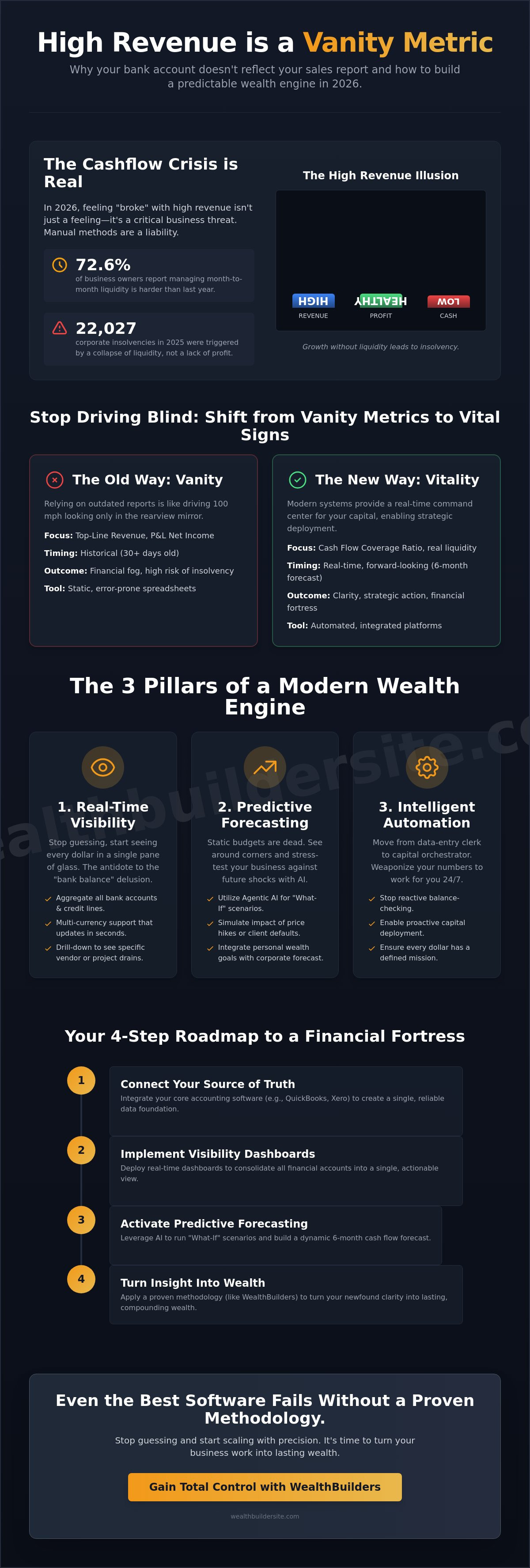
Why are you celebrating a record-breaking sales month when your payroll check is about to bounce? Revenue is a seductive lie. It tells you how much you've promised to collect; it says nothing about the actual survival of your firm. In 2025, 22,027 corporate insolvencies were triggered not by a lack of profit, but by a total collapse of liquidity. If your strategy relies on a P&L statement that is thirty days old, you're driving a high-performance machine at 100 mph while looking only in the rearview mirror. You don't have a business problem; you have a visibility problem.
Modern cashflow management tools are the tactical solution to this blind spot. Unlike traditional accounting, which records the past for tax purposes, these systems provide a real-time command center for the movement of capital. Effective cash management allows you to see the velocity of your money before it leaves your control. In a 2026 economy defined by high interest rates and shifting supply chains, manual spreadsheets are no longer just "old school." They are a liability. One broken cell or outdated entry can mask a six-figure deficit until it's too late to pivot. If you can't see your cash gaps six months in advance, you aren't managing; you're gambling.
The Psychology of the Cash-Rich Entrepreneur
Most operators live in a state of "financial fog." This uncertainty breeds a fear-based decision-making cycle. You hoard capital when you should be investing, or you over-leverage exactly when you should retreat. When you implement professional systems, the fog lifts. You stop reacting to bank balances and start acting as a steward of resources. This is the mindset shift we facilitate through WealthBuilders Coaching. You transition from an exhausted operator into a strategic wealth builder who understands that every dollar in your ecosystem must have a mission. Stewardship isn't just about saving; it's about the precision of deployment.
Vanity Metrics vs. Vital Signs
Your P&L might show a healthy net income, but if your receivables are lagging and your debt service is spiking, you are effectively insolvent. You must stop obsessing over top-line growth and start monitoring your Cash Flow Coverage Ratio. This metric measures your ability to meet obligations with actual cash on hand rather than theoretical earnings. If this ratio drops, your growth will eventually kill you. High-tier cashflow management tools function as the digital oxygen of business scaling, ensuring that as you grow, your wealth actually compounds instead of evaporating into operational friction.
The 3 Pillars of Modern Cash Flow Management Tools
If you're still managing your empire by logging into five different bank portals every morning, you aren't a CEO; you're a data entry clerk. High-stakes growth requires a move away from reactive balance-checking toward proactive capital orchestration. Modern cashflow management tools aren't just about "knowing" your numbers. They are about weaponizing them. To build a true wealth engine, your stack must stand on three non-negotiable pillars: visibility, forecasting, and automation. If your current system lacks even one of these, you're leaving your financial protection to chance.
Real-Time Visibility: No More "Bank Balance" Accounting
Real-time visibility is the antidote to the "bank balance" delusion. You need dashboards that aggregate every bank account, credit line, and outstanding invoice into a single pane of glass. For those scaling globally, this means multi-entity and multi-currency support that updates in seconds, not days. You need "Drill-Down" capabilities that allow you to see the specific vendor or project draining your margin. This level of insight is a core component of effective business automation software. If you can't see the leak, you can't plug it. Stop guessing and start seeing.
Predictive Forecasting: Seeing Around Corners
Static budgets are dead. In 2026, the focus has shifted to agentic AI that plans and executes actions based on your financial goals. Modern tools use your historical data to simulate "What-If" scenarios. What happens if your main supplier raises prices by 15%? What if a client defaults on a major contract? Predictive forecasting allows you to see these corners before you turn them. This isn't just about business survival; it's about integrating your personal wealth goals into your corporate forecast. If your business doesn't serve your life, it's just an expensive hobby. You must align your operations with the principles we teach in our Business Workshop to ensure your growth is sustainable.
The final pillar is automation. Systems must handle receivables and payables without human intervention. At WealthBuilders, we hold a strict standard: if a tool doesn't save you at least five hours a week, it's a toy, not a strategic asset. You shouldn't be chasing invoices; your software should. When you automate the mundane, you free your mind for the strategic. Implementing these cashflow management tools is the only way to move from operator to owner. If your tools don't buy back your time, they are costing you more than money. It's time to build a fortress around your capital.
Evaluating the 2026 Cash Flow Stack: Power Players vs. Legacy Laggards
Are you still relying on QuickBooks as your only financial defense? If so, you're bringing a knife to a gunfight. In 2026, legacy platforms like QuickBooks and Xero are necessary for tax compliance, but they are no longer sufficient for strategic growth. They tell you what happened last month. They don't tell you if you'll run out of cash next Tuesday. To win, you must layer specialized cashflow management tools on top of your accounting foundation. If your current stack doesn't provide a forward-looking window, you're flying blind in a storm.
Specialists like Float, Pulse, and Tidely have become the standard for ambitious entrepreneurs. Why? Because they focus on one thing: the future. While your accounting software is buried in the past, these tools use live data to project your liquidity. If you're managing multiple entities or high-volume transactions, leveling up to enterprise contenders like Sage Intacct or Oracle NetSuite becomes inevitable. These aren't just software upgrades; they are tactical pivots for those ready to dominate their market. The emerging AI disruptors in this space are now capable of automating 90% of financial data entry, effectively removing the "human error" variable from your wealth equation.
Software Comparison: Functionality vs. Complexity
Choosing the wrong tool is a recipe for operational friction. You must select your stack based on your current revenue tier and three-year growth targets. If your annual revenue is under $1 million, a complex enterprise ERP will crush your team under its own weight. Conversely, if you're doing $10 million, a basic spreadsheet integration is a recipe for disaster. Watch for "Red Flags" in legacy systems. If you have to manually export data to see your cash position, your system is broken. A true wealth-generating machine requires real-time, bi-directional syncs that eliminate the need for manual oversight.
Cost vs. Value: The ROI of Financial Clarity
Stop looking at the monthly subscription price. Start calculating the "Cost of Ignorance." What does one missed cash gap cost you in late fees, missed investment opportunities, or emergency high-interest loans? With SBA 7(a) variable rates currently sitting between 9.0% and 11.5% in May 2026, relying on expensive debt because you didn't see a shortfall coming is a failure of leadership. Automation pays for itself by slashing administrative headcount and providing the clarity needed to scale without fear. Ultimately, the best tool is the one that aligns with your passive income engine, ensuring that your business generates wealth while you sleep. Precision in your tools leads to freedom in your life.
Building Your Financial Fortress: A 4-Step Implementation Roadmap
Knowledge without execution is just noise. If you don't have a structured process for implementation, you've just added another monthly subscription to your list of liabilities. You need a system that survives your growth. Building a financial fortress requires more than a login; it requires a roadmap that moves you from chaos to total control. If you're still re-entering invoice data into a spreadsheet, you're bleeding time that should be spent on high-level strategy. It's time to stop wandering through a financial minefield and start building a predictable wealth engine.
The first step is to audit your current data flow and identify manual bottlenecks. Where does the friction exist? If you're waiting on a bookkeeper to send a report before you can make a decision, your system is broken. Step two requires you to connect your "Source of Truth" (accounting) to your "Strategy Tool" (forecasting). Your cashflow management tools must speak directly to your bank feeds and ledger without human intervention. Step three is about establishing rituals. Without a rhythm, your strategy will fail. Finally, step four is to automate every low-value task. Buy back your time so you can focus on high-level wealth creation. If a machine can do it, a human shouldn't.
The 30-Day Setup: From Chaos to Clarity
You can transform your financial visibility in less than a month if you follow a disciplined framework. Week 1 is about cleaning the Chart of Accounts. If your categories are a mess, your reports will be useless. Garbage in, garbage out. Week 2 focuses on integration. Connect your bank feeds and automate your invoice reminders. With 58% of small businesses now using AI tools as of May 2026, you're already falling behind if you aren't leveraging automation. Week 3 is the breakthrough: running your first 6-month forecast simulation. This is where you start seeing around corners and predicting cash gaps before they become crises.
Establishing Your Weekly Wealth Review
Every Friday morning, you must confront the reality of your numbers. Real wealth builders don't hide from data; they use it to dominate. Ask yourself: What is my current liquidity? Where is the friction in my receivables? How much capital can I move into my wealth engine this week? This level of clarity gives you the leverage to negotiate better terms with vendors. If you can show a vendor that your cash position is rock-solid, you can command better pricing. This ritual also ensures you are systemizing your stewardship. By applying the principles found in God's Road to Financial Freedom, you ensure that your tithes and giving are a foundational part of your wealth engine rather than an afterthought. If you're ready to stop being a slave to your bank balance, join us at our next Business Workshop to master these frameworks in person.
Beyond the Software: Mastering Money for True Freedom
Do you really think a piece of software is going to save you? A tool is only as effective as the hand that wields it. You can have the most expensive cashflow management tools on the market, but if you lack a proven methodology, you're just watching your money disappear in high definition. True freedom isn't found in a dashboard; it's found in the strategy behind the data. If you don't know how to interpret the signals your business is sending, you'll remain a slave to your bank balance regardless of how many apps you install. You must move from "managing cash" to "building a legacy."
This is where the intersection of business systems and biblical financial freedom becomes your greatest competitive advantage. When you have total visibility into your capital movement, you gain the confidence to make high-stakes moves that others fear. You stop wondering if you can afford an investment and start knowing exactly when to strike. This clarity is your tactical advantage for entering the real estate market. It allows you to move surplus capital from a "work" environment into a "wealth" environment, turning operational profit into permanent assets. If your business doesn't fund your real estate portfolio, you're missing the entire point of entrepreneurship.
The WealthBuilders University Advantage
Our students scale faster because they don't just collect data; they master it. Through WealthBuilders University, we provide the mental frameworks required to turn raw numbers into strategic decisions. Our coaching programs help you decode the complex reports your cashflow management tools generate, ensuring you never miss a growth opportunity due to a financial blind spot. We teach you how to align your business operations with the principles of stewardship found in God's Road to Financial Freedom. When your systems are rooted in proven truth, your growth becomes inevitable.
Your Next High-Stakes Move
Information overload is the silent killer of the modern professional. You've read the strategy, you've seen the roadmap, and you know the tools. Now, you face a choice. 2026 is the year of the "Systematized Entrepreneur." Those who refuse to automate their financial visibility will be crushed by the speed of the market. Those who embrace it will buy back their time and build fortresses that last for generations. Will you continue to guess your way through your next growth phase, or will you start to build a predictable wealth engine? The gate to elite status is open, but only for those ready to execute. It's time to stop playing the game and start winning it.
Stop Playing Defense and Start Building Your Empire
Will you continue to let your bank balance dictate your stress levels? If you choose to ignore the systems we've discussed, you're choosing to stay in the "profitability trap" where growth leads to insolvency. You've learned that cashflow management tools are the only way to gain 6-month visibility and automate the low-value tasks currently eating your time. The market in 2026 doesn't reward those who guess. It rewards those who govern their capital with tactical precision. You have the roadmap; now you need the execution.
Founded by Billy Epperhart, WealthBuilders provides the strategic frameworks used by thousands of entrepreneurs to bridge the gap between business work and lasting wealth. We don't just offer software suggestions. We provide biblically-grounded wealth building systems that transform how you view stewardship and capital deployment. It's time to decide if you're an operator or an owner. Your financial fortress is waiting to be built, but it requires a commitment to proven methodologies over speculative shortcuts.
Ready to stop guessing? Join WealthBuilders University and master your money today.
You have the potential to build a legacy that lasts for generations. Take the first step toward true financial command today.
Frequently Asked Questions
What is the best cash flow management tool for a small business in 2026?
The "best" tool depends entirely on your revenue tier and the complexity of your growth targets. For businesses focused on predictive forecasting, specialized cashflow management tools like Float or Pulse are the current market leaders. If you're managing rental income alongside your business, the Monarch Money Plus plan released in 2026 offers advanced tracking for $199 per year. Choose the tool that integrates seamlessly with your current ledger to avoid manual data friction.
Can I manage cash flow using only QuickBooks or Xero?
You can't build a future by only looking at the past. QuickBooks and Xero are excellent for tax compliance and historical records, but they lack the dynamic forecasting required for strategic wealth building. Relying solely on your accounting software is like driving a car while only looking at the rearview mirror. You need a dedicated layer that projects liquidity at least six months into the future.
How often should I update my cash flow forecast?
Your forecast should update in real-time through automated bank feeds. However, you must perform a deep strategic review at least once a week. We recommend a "Friday Wealth Ritual" where you confront your numbers and adjust for upcoming variables. If you aren't looking at your capital movement weekly, you're abdicating your role as a steward and leaving your business survival to chance.
What is the difference between an accounting tool and a cash flow tool?
Accounting tools focus on accuracy for the past; cashflow management tools focus on visibility for the future. Accounting tracks what you've spent and what you're owed for tax and compliance purposes. Cash flow tools aggregate your real-time liquidity to show you when you might hit a deficit. One is about staying legal; the other is about staying alive and scaling your wealth.
How much do cash flow management tools typically cost?
Pricing varies based on your complexity and user count. In 2026, the Float Professional plan starts at $100 per month for ten users, while Monarch Money offers a Core plan for $14.99 per month. Enterprise solutions like Sage Intacct require custom quotes but offer significantly deeper automation. Don't focus on the subscription fee; focus on the ROI of avoiding a single liquidity crisis.
Do I need a CFO to use these cash flow management tools?
You don't need a high-priced executive to manage these systems if you have the right methodology. Modern software is designed to be user-friendly for the strategic owner. While a CFO adds value during complex mergers or acquisitions, the right tools allow you to handle daily liquidity and forecasting yourself. This is why we focus on teaching these frameworks in our Business Workshop.
Is it possible to automate my entire cash flow management process?
You can automate up to 90% of the data entry and reporting through agentic AI and ISO 20022 global messaging standards. However, you cannot automate the strategy. While your tools can flag a future cash gap, you must be the one to decide whether to cut expenses, delay a project, or secure financing. Automation buys you the time to be a leader instead of a bookkeeper.
How do these tools handle 'What-If' scenarios for business scaling?
These tools use historical data to run simulations based on variables you control. You can model what happens if your SBA 7(a) variable rate climbs to 11.5% or if a major client delays payment by 45 days. By testing these high-stakes scenarios in a digital environment, you protect your real-world assets. You stop guessing and start making data-backed decisions that safeguard your legacy.