
What if the very tasks you think are "running" your company are actually the ones killing its future? You're currently trading your life for a paycheck, stuck in the grind of manual responses and administrative loops while your competitors use 2026 technology to outpace you. The truth is that business automation for small business isn't a luxury for the elite; it's the baseline for survival in a market where 82% of small business employers have already invested in AI tools. If you're still working "in" the business instead of "on" it, you aren't an owner. You're an employee with a very expensive title.
It's exhausting to watch leads slip through the cracks because you couldn't reply in time. You likely believe that automation is too expensive or that it will strip away your personal touch, but those myths are the only things keeping you stagnant. We're going to dismantle those lies and show you how to reclaim 10 to 20 hours per week by leveraging the shift toward agentic AI and no-code platforms. This isn't about a simple software upgrade. It's about a fundamental transition to predictable, scalable growth. You'll discover the exact frameworks needed to build a business that finally runs without your constant, frantic presence.
Key Takeaways
- Understand why your current reliance on manual labor is a ceiling on your growth rather than a badge of honor.
- Learn why business automation for small business actually protects your brand's personal touch instead of diluting it.
- Distinguish between buying tools and building systems to avoid the common trap of expensive, disconnected software subscriptions.
- Implement a 4-step strategic framework designed to eliminate operational waste and map a frictionless journey for your customers.
- See how WealthBuilders University integrates these high-level operational frameworks into a comprehensive path toward financial freedom.
The Small Business Trap: Why Manual Work is Your Biggest Competitive Threat
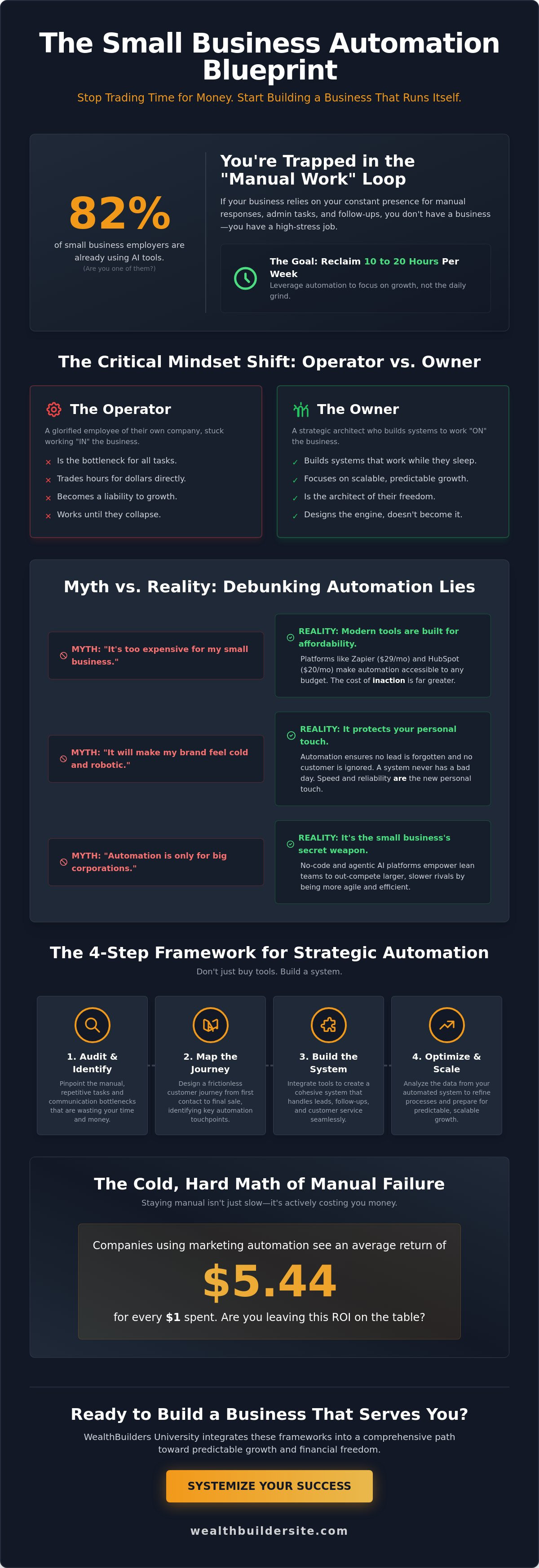
You've been lied to. You likely believe that grinding sixteen hours a day is a badge of honor, but in 2026, it's actually a sign of strategic failure. Hard work is not the only path to success. If your business requires your physical or mental presence to execute every basic task, you don't own a business; you own a high-stress job that you can't quit. This is the manual growth ceiling. It's a hard limit on your revenue because there are only so many hours you can trade before you break. Staying manual is a high-stakes gamble against competitors who are already utilizing Business process automation (BPA) to outpace your every move.
The hidden cost of human error is quietly bleeding your accounts dry. When a lead comes in at 2:00 AM and sits in an inbox until 9:00 AM, that prospect is already gone. They've moved on to the competitor whose system responded in seconds. Relying on manual follow-up and customer retention is a liability you can no longer afford. Implementing business automation for small business isn't just about saving time. It's about eliminating the friction that prevents you from scaling your impact and your income.
The Operator vs. The Owner Mindset
Are you a strategic leader or just a glorified employee of your own company? If you're the one manually checking every invoice and sending every "thank you" email, you are the bottleneck. Your presence in these low-level tasks makes you a liability. An owner builds systems that work while they sleep. An operator works until they collapse. To scale, you must stop being the engine and start being the architect. Realize that your business should be a vehicle for your freedom, not a cage for your time.
The Math of Manual Failure
Let's look at the cold, hard numbers. In a 24/7 digital economy, the cost of a missed lead can be thousands in lost lifetime value. Statistics show that companies using marketing automation see an average return of $5.44 for every $1 spent. If you aren't automating, you're leaving that ROI on the table for someone else to claim. Manual workflows don't just slow you down; they prevent you from ever achieving true WealthBuilders University style freedom. The compounding effect of automated efficiency over 12 months can mean the difference between a stagnant side-hustle and a predictable, scalable empire. If you don't build a system to manage your growth, your growth will eventually manage you.
Myth vs. Reality: Debunking the Top 5 Automation Misconceptions
Are you letting outdated assumptions dictate your financial ceiling? Most entrepreneurs treat automation like a dark art reserved for those with seven-figure IT budgets. This ignorance is exactly why 93% of small businesses anticipate growth in 2026, yet only the ones with systems will actually achieve it. If you're waiting for the "perfect time" to modernize, you're already losing. Let's dismantle the lies keeping your operations manual and stagnant.
The first and most damaging myth is that automation is only for "Big Tech" or enterprise-level corporations. This is a relic of the early 2000s. Today, What is Business Automation? It's a modular, accessible strategy that any lean team can deploy. If you can use a smartphone, you can implement business automation for small business to outcompete larger, slower rivals. Closely following this is the myth of the "Set it and Forget it" magic pill. Automation is an engine, not a statue. It requires periodic optimization to stay aligned with your scaling revenue. Finally, many believe it's too expensive. When Zapier offers Professional Plans for $29.99 a month and HubSpot provides Starter platforms for about $20, the "too expensive" excuse is just a mask for a lack of vision.
Can Robots Actually Be More "Personal" Than Humans?
You fear that automation will make your business feel cold or robotic. The reality is the opposite. Humans are forgetful; they miss emails, forget follow-ups, and get tired. A well-designed system ensures no customer ever feels ignored. In 2026, the highest form of customer service is speed. If you can provide an instant, accurate response at 3:00 AM, that's more "personal" than a human replying three days later. Use a hybrid approach: automate the mundane tasks to liberate your team for high-value human interaction.
The Truth About Technical Complexity
Stop using the "I'm not techy" excuse to hold your bank account hostage. The rise of no-code tools has democratized business systems. You don't need a computer science degree to build a workflow; you just need to understand your own process architecture. We've moved from a world of complex coding to one of logical "if/then" scenarios. If a lead fills out a form, then they receive your welcome sequence. It's that simple. If you're ready to stop playing small and start building a real system, the Business Workshop is your next logical step.
Systems vs. Tools: Why Your Software Isn’t Scaling Your Business
Do you honestly believe that adding another app to your phone will magically solve your scaling problems? Most entrepreneurs are addicted to "Shiny Object Syndrome," throwing thousands of dollars at tech they never actually use. You're treating tools like they are the solution when they are actually just the delivery mechanism. A tool is a hammer; a system is the blueprint for the house. If you don't have the blueprint, you're just swinging a hammer at a pile of wood and wondering why you don't have a mansion yet. Buying business automation software will not fix a broken process. It will only make your failures happen faster and at a higher cost.
Effective business automation for small business requires absolute alignment with your long-term wealth goals. Every piece of tech in your stack must serve a specific purpose within a larger framework. If your software isn't talking to each other, you've just created a digital version of the manual labor you were trying to escape. You're paying for subscriptions to work harder, not smarter.
The Hierarchy of Business Automation
- Layer 1: Communication. This is your frontline. It includes automated emails, SMS alerts, and lead follow-up sequences. If a human has to manually type "thank you" every time, you're failing at the most basic level.
- Layer 2: Operations. This covers the "guts" of your business. Onboarding new clients, project management workflows, and billing cycles. This layer ensures the work gets done without your constant supervision.
- Layer 3: Strategy. The elite level. This involves data reporting, financial forecasting, and growth loops. This is where you move from guessing to knowing.
Why "Disconnected Tools" are Killing Your Productivity
You are likely living in a nightmare of "Data Silos." This happens when your CRM doesn't talk to your accounting software, forcing you or an employee into hours of manual data entry. It's a waste of human potential. The power of true business automation for small business lies in integration. You need your software to communicate so you don't have to. When your tools are connected, information flows seamlessly from a lead capture to a closed sale and into your financial reports. Stop collecting apps and start building architecture. A Business System is a repeatable sequence that produces a predictable result.
The 4-Step Framework for Strategic Automation
Why are you still guessing? Most owners fail because they treat software like a magic wand rather than a structural component. If you automate a chaotic, manual workflow, you simply create a faster way to go broke. True business automation for small business is a surgical procedure. It requires a cold, calculated sequence to move you from a stressed operator to a strategic owner. Stop playing games with your future and follow a proven architectural blueprint.
- Step 1: Audit and Eliminate. If a task doesn't directly contribute to your revenue or customer experience, kill it. Don't waste resources automating what shouldn't exist in the first place.
- Step 2: Map the "Ideal Path." Document the perfect journey from the first lead touchpoint to the final sale. If you can't draw the process on a whiteboard, you have no business trying to code it into a CRM.
- Step 3: Select Your Tech Stack. Choose tools based on strategy, not hype. With 75% of SMBs now investing in AI according to 2026 data, the market is crowded with distractions. Choose tools that talk to each other. Your goal is a unified system, not a collection of digital paperweights.
- Step 4: Iterate and Optimize. Refine the system using the 80/20 rule. Small tweaks in your automated sequences can lead to a 14.5% increase in sales productivity.
Auditing Your Time: The 80/20 Rule of Tasks
Identify the 20% of activities that generate 80% of your wealth. Everything else is a distraction. Use a "Stop Doing" list to clear the mental and operational clutter before you touch a single line of automation. If you want to dive deeper into these mapping strategies, check out our business building guide to see why systems always trump sweat. Stop valuing "busy-ness" and start valuing outcomes.
Building the "Self-Healing" Business
A truly automated business is self-healing. This means you create triggers that only alert you when a system fails or a specific human intervention is required. If a payment fails, the system should handle the retries and notifications automatically. You only step in when the machine hits a wall. Use fail-safes to protect your reputation. Test every workflow with "dummy" data before you subject your real customers to a broken sequence. If you're ready to build a business that actually serves you, the Business Workshop is your next tactical move.
Joining the Elite: How WealthBuilders University Systemizes Your Success
Why do most wealth building programs fail to move the needle for your bank account? It's because they focus on speculative theories and mindset shifts while ignoring the mechanical engine of your business. You can have all the vision in the world, but if your daily operations are a manual mess, you'll never have the time to execute it. Most gurus tell you to work harder; we tell you to build better. We move beyond the "hustle" and teach you how to implement business automation for small business as a foundational pillar of lasting wealth. This is where biblical stewardship meets modern efficiency.
The transition from chaos to clarity isn't accidental. It's the result of a deliberate shift in your identity. You must stop being the "Chief Everything Officer" and start being the visionary leader your company actually needs. If you're still the one answering every basic inquiry or manually tracking every lead, you're a bottleneck to your own blessing. WealthBuilders University provides the blueprint to help you step out of the grind and into a role where you oversee a system that produces results without your constant, frantic presence.
The Curriculum for Automated Wealth
Our framework doesn't just give you a list of apps. We teach you how to build systems that produce passive income and predictable growth. You'll join a community of high-level entrepreneurs who have already escaped the manual trap and are now operating at an elite level. In 2026, the market is unforgiving to those who resist change. You must choose: will you automate your path to freedom, or will you stagnate in the manual methods of the past? We provide the curated, data-backed methodologies that ensure your business automation for small business strategy actually scales your revenue instead of just increasing your tech bill.
Take the First Step Toward Freedom
Stop speculating on what might work and start implementing what is already proven. You've spent enough time trading your life for a paycheck. It's time to build a vehicle that works for you. This is your invitation to leave the ranks of the overworked and join the strategic insiders who have decoded the market. Your business is either a system that serves you, or a job that owns you. Which one did you wake up to this morning? Decisions define your destiny. Stop waiting for a "better time" and start building your legacy today.
Enroll in WealthBuilders University Today
Stop Playing the Operator Game and Start Building Your Legacy
Will you continue to trade your life for a paycheck, or are you finally ready to build a vehicle that actually scales? You've seen how manual work acts as a ceiling on your revenue and how the "personal touch" myth is just a mask for operational inefficiency. Implementing business automation for small business is no longer a choice for the ambitious; it's the only logical next step to protect your time and your wealth. If you don't build a system that runs without you, then you've simply built a cage that requires your constant presence to stay locked.
You don't have to navigate this transformation alone. Led by seasoned strategist Billy Epperhart, WealthBuilders University offers the proven frameworks for financial freedom that have already helped a community of 10,000+ like-minded entrepreneurs escape the grind. It's time to stop speculating and start executing with precision. Your legacy is waiting for the visionary leader you were meant to be. Take the shortcut to elite performance and secure your future today.
Master the Systems of Wealth at WealthBuilders University
Frequently Asked Questions
Is business automation expensive for a small business in 2026?
It's actually more expensive to remain manual and stagnant. With platforms like Zapier offering professional plans for $29.99 and HubSpot providing starter platforms for approximately $20 per month, the entry price is negligible. You aren't paying for software; you're buying back your time. If you refuse to invest, you're choosing to pay with your life instead of your bank account.
How do I know which tasks I should automate first?
Start with the tasks that steal your time but don't grow your wealth. Small business owners often spend up to 16 hours per week on repetitive administrative work. Audit your calendar and identify anything you do more than three times a week. If it involves moving data or sending standard replies, it's a prime candidate for your first workflow.
Will I lose my personal connection with customers if I use automation?
You'll actually improve it by being more responsive. Speed of response is the highest form of customer service in the 2026 digital economy. Using business automation for small business allows you to deliver instant, personalized experiences that 77% of marketers now use to build deeper trust. Machines handle the speed so humans can handle the depth.
What are the best automation tools for a startup with no tech background?
Focus on no-code platforms that prioritize user experience over technical jargon. QuickBooks Online starts at $35 a month for basic accounting, while Mailchimp offers advanced automation starting at $20. Similarly, you can learn more about Parcel International to find automated shipping and logistics solutions that integrate with your tech stack. These tools are designed for entrepreneurs, not developers. You don't need a degree to build a system; you just need the discipline to map your process before you buy the subscription.
Can automation help me scale without hiring more employees?
Yes, it acts as a force multiplier for your existing team. Marketing automation can lead to a 14.5% increase in sales productivity without adding a single person to your payroll. By implementing business automation for small business, you can manage a 451% increase in qualified leads while keeping your overhead lean and your profit margins high.
How long does it take to see a return on investment from automation?
Most businesses see a measurable impact faster than they expect. Data shows that 76% of companies achieve a positive ROI within the first year of implementation. Every $1 spent on marketing automation typically returns $5.44. If you aren't seeing these numbers, your system is likely broken or your strategy is non-existent.
What happens if the automated system makes a mistake?
You must build "self-healing" triggers and fail-safes into your architecture. Systems don't just "break" on their own; they usually fail because of poor data quality or a lack of human oversight. Set up alerts that notify you only when a workflow hits a wall. This ensures you remain the strategic visionary rather than a full-time troubleshooter.
Do I need to change my entire business model to start automating?
No, you're simply upgrading the engine. You don't change the destination; you change the vehicle. Automation is about refining your existing architecture so it produces a predictable result every time. If your current model relies on you doing everything, then yes, that model must die so your business can finally live.