
Is your payroll a ladder or a noose? In 2026, every new hire you add is a potential anchor dragging down your agility and profit margins. Scaling business without employees isn't just a lifestyle choice anymore; it's the only way to survive a market where 83 million Americans are already freelancing and AI agents handle the heavy lifting for less than the cost of a daily latte. If you continue to equate growth with headcount, then you're choosing to remain the permanent bottleneck of your own operation.
You likely started this journey for freedom, yet you find yourself drowning in manual tasks and the suffocating overhead of a traditional team. It's a common trap, but it's one that leads to stagnation rather than wealth. This article promises to show you how to break that cycle by using systems and strategic leverage to maximize revenue while keeping your overhead lean. We will explore the latest automation frameworks, the rise of fractional leadership, and the specific 2026 regulatory shifts that make a lean model the most secure path to elite status.
Key Takeaways
- Understand why traditional hiring has become a strategic liability in 2026 and how it traps you in a cycle of management complexity rather than profit.
- Master the three pillars of modern leverage—code, content, and capital—to build a high-margin engine that generates revenue without constant human intervention.
- Discover the exact methodology for scaling business without employees by replacing human friction with permanent, high-efficiency systems that don't call in sick.
- Follow a proven four-step protocol to audit your current operations, eliminate non-essential "busy work," and automate the mundane tasks that steal your focus.
- Learn how WealthBuilders University provides the specific data-backed blueprints needed to transition from a bottlenecked founder to a strategic architect of wealth.
The Headcount Trap: Why Hiring is Often a Scaling Failure
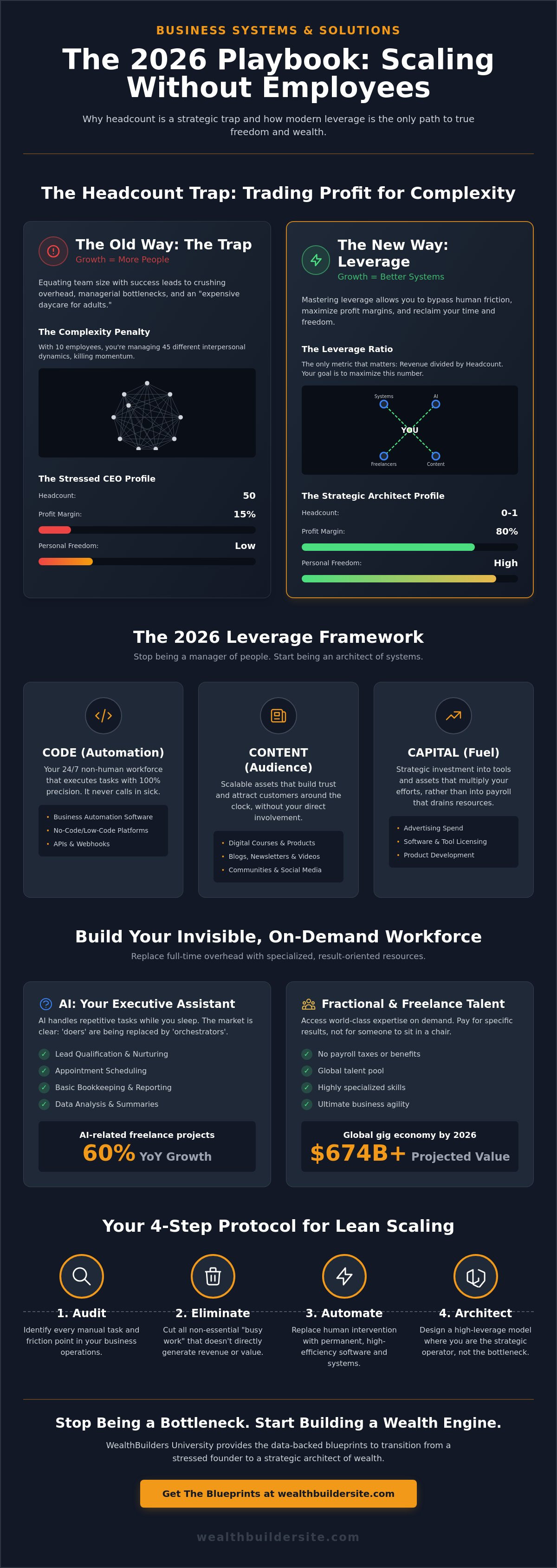
If you believe that a growing team is the primary indicator of a successful business, you're playing an outdated game. In the high-stakes environment of 2026, a massive payroll isn't a badge of honor; it's a liability that drains your most precious resources. The Headcount Trap occurs when an entrepreneur trades lean profit margins for crushing management complexity. You think you're building an empire, but you're actually creating an expensive daycare for adults where your primary role is conflict resolution rather than strategic growth. If your revenue goes up but your personal freedom goes down, you haven't scaled. You've just built a bigger cage.
Scaling business without employees is no longer a fringe theory for the lazy. It's the elite strategy for those who value freedom as much as they value revenue. With the global gig economy projected to reach up to $674.1 billion in 2026, the infrastructure to replace full-time staff with on-demand talent is already here. Traditional Bootstrapping focused on survival with limited funds, but modern lean leverage focuses on dominance through systems. The hidden costs of employees go far beyond payroll taxes and healthcare benefits. There's an emotional tax that comes with every new hire. If you spend 40% of your week managing people's moods and mistakes, you aren't a CEO. You're a babysitter.
The Complexity Penalty
Every time you add a human to your organization, the lines of communication don't just grow; they explode. If you have two people, there is one line of communication. If you have five, there are ten. By the time you reach ten employees, you're managing forty-five different interpersonal dynamics. This is the Managerial Bottleneck. Your job shifts from innovating and selling to simply ensuring that information moves from point A to point B without getting distorted. Scaling business without employees allows you to bypass this friction entirely. Lean businesses out-profit their larger competitors because they don't have to pay for the bureaucratic lag that kills momentum.
Reframing Success Metrics
Stop bragging about how many people sit in your office. Start bragging about your profit per hour. In 2025, a record 5.6 million independent workers in the U.S. earned over $100,000, proving that you don't need a cubicle farm to hit six or seven figures. The only metric that matters is your Leverage Ratio: total revenue divided by headcount. If you're a stressed eight-figure CEO with a 15% margin and 50 employees, you're actually losing to the seven-figure solopreneur who keeps 80% of their revenue. One is a slave to their overhead; the other has mastered the art of lean leverage.
The 2026 Leverage Framework: Software, AI, and Productization
Why are you still hiring humans to perform tasks that a few lines of code can execute with 100% precision? If you want to win the competitive game of 2026, you must stop being a manager of people and start being an architect of systems. Modern leverage is built on three pillars: Code, Content, and Capital. While capital used to be the gatekeeper, code and content have democratized the ability to reach millions without a single office cubicle. Code doesn't get sick. Content doesn't ask for a raise. When you deploy business automation software, you're hiring a non-human workforce that operates 24/7 for a fraction of a minimum wage salary.
In 2026, AI has evolved from a novelty into a sophisticated executive assistant. It handles lead qualification, appointment scheduling, and even basic bookkeeping while you sleep. With AI-related freelance projects seeing a 60% year-over-year increase, the market is signaling a clear shift: the "doers" are being replaced by "orchestrators." If you refuse to integrate these agents into your core processes, you're choosing to work harder for less money. True scaling business without employees isn't about doing everything yourself; it's about ensuring you are the only human required to make the high-level decisions that drive the machine.
Building Your Tech Stack
The secret to a lean empire is interoperability. You don't need a massive IT department when you choose online business tools that talk to each other through APIs and webhooks. The no-code revolution is expected to reach a $50 billion market value by 2028, allowing you to build custom internal software without writing a single line of syntax. By automating the customer journey from the first click to final fulfillment, you eliminate the human friction that usually kills profit margins. If your systems are fragmented, your time will be too. If you're ready to master these frameworks, our Business Workshop provides the tactical roadmap you need.
Productizing Your Genius
Custom work is the silent killer of scalability. If every client requires a unique solution, you can't scale without adding more bodies to handle the labor. You must turn your expertise into a product. This means developing rigid standard operating procedures (SOPs) and using auto-fulfillment to improve efficiency across your entire delivery model. Packaging your knowledge into digital assets or standardized service packages allows you to sell the same result a thousand times. You move from being a craftsman to being a factory owner. If your business depends on your specific manual labor to deliver value, you don't own a business; you own a job.
Systemization vs. Delegation: Building the Invisible Team
Are you delegating tasks or are you building an asset? Most entrepreneurs confuse the two, and that's why they never truly achieve scaling business without employees. Delegation is a temporary band-aid that relies on another human's mood, presence, and interpretation. Systemization is a permanent cure. If you tell a person what to do, you've solved a problem for today. If you build a system to handle the task, you've solved it forever. The "Invisible Team" consists of logic-based workflows that execute your strategy 24/7 without human negotiation or payroll taxes.
To start, you must audit your time with ruthless precision. If a task is repeatable, it is system-ready. If it requires "your special touch," you're likely lying to yourself to maintain a sense of importance. Successful business system implementation transforms your operation from a chaotic hub-and-spoke model, where you are the hub, into a self-correcting machine. In this new paradigm, your job isn't to work in the business; it's to monitor the dashboard of the machine you've built.
The SOP Powerhouse
Static, dusty manuals are dead. In 2026, you need "Living SOPs" that use video and AI-driven documentation to capture your methodology. Ask yourself the Transfer of Knowledge test: Could your business run if you disappeared for a month? If the answer is no, you are the bottleneck. By turning every client interaction and lead follow-up into a repeatable process, you remove the "expert" requirement from the equation. You move from a model of variable human performance to one of predictable system output. Precision is the only way to protect your margins.
Strategic Outsourcing
Scaling without a massive payroll doesn't mean doing everything yourself. It means leveraging fractional experts who provide high-level results without the high-level overhead. With demand for fractional leadership projected to increase by 40% in 2026, you can now hire a part-time CFO or COO for the cost of a junior manager. Treat these vendors as "System Nodes" rather than employees. You aren't managing their time; you're managing their output. With over 83 million Americans engaged in freelance work, the gig economy is your on-demand resource pool. Use it to plug holes in your system, not to build a traditional hierarchy. If you can't manage a vendor through a clear contract and a systemized workflow, you'll never be able to manage a team.
The 4-Step Protocol for Lean Scaling
Will you continue to mistake motion for progress? Most entrepreneurs spend 80% of their time on 20% of the activities that actually move the needle. Scaling business without employees requires a surgical approach to your daily operations. You cannot automate a mess. If your current workflow is a tangled web of manual emails and sticky notes, adding software will only make the failure happen faster. You need a protocol that moves you from chaos to a predictable, revenue-generating engine. This isn't about working harder; it's about building a machine that works for you.
The protocol follows a rigid sequence. First, you must Audit and Eliminate, cutting the "busy work" that feels productive but doesn't drive revenue. Second, you Automate the Mundane using tools like Zapier and Make to handle data entry and admin. Third, you Productize the Value by creating a "fixed" offer that requires zero custom input for each new client. Finally, you Scale the Traffic using automated marketing funnels to fuel the engine. If you miss a step, the entire structure collapses under its own weight. If you are ready to stop guessing and start building, apply for WealthBuilders Coaching to implement this protocol with precision.
Phase 1: The Operational Audit
You must identify the high-impact work that only you can do. Everything else is a candidate for elimination or automation. Map your current processes, even the messy ones, before you attempt to touch a single piece of software. Apply the 80/20 rule to your client list. If 20% of your clients are causing 80% of your headaches, fire them. You cannot scale a lean business while being weighed down by low-value, high-maintenance relationships. Precision in your audit is the foundation of your future freedom.
Phase 2: The Automation Build
Your CRM is the brain of your operations. It must be the single source of truth that triggers every other action in your business. Integrate your payment and fulfillment systems so that when a client pays, the onboarding happens instantly without you lifting a finger. This creates a hands-off experience that customers in 2026 now expect as a standard of professional service. The Automation Loop is a continuous feedback mechanism where system performance data informs immediate workflow adjustments to maintain peak efficiency. This is the only logical path for scaling business without employees in a saturated market.
Beyond the Solopreneur: WealthBuilders University as Your Scaling Engine
Will you continue to be the engine of your business, or will you build an engine that doesn't need you? Scaling is a high-level skill, a tactical methodology that separates the elite from the exhausted. Business Systems & Solutions provides the specific, data-backed blueprints required for this transformation. Transitioning from a stressed operator to a strategic architect isn't just a shift in mindset. It's a shift in architecture. WealthBuilders University, the premier offering from Business Systems & Solutions, exists to bridge the gap between your current stagnation and your future freedom.
The connection between business automation and long-term financial freedom is absolute. If your revenue depends on your physical presence, you don't own a business; you own a high-stress job. scaling business without employees allows you to reclaim your time, which is the only non-renewable resource you have. By removing yourself from the daily operations, you create the mental space necessary to focus on high-level wealth creation. Business Systems & Solutions ensures you aren't just building for today, but protecting your future wealth from the friction of traditional management.
The WealthBuilders Framework
Business cash flow is a tool, not the final destination. The framework at Business Systems & Solutions teaches you how to use that cash flow to fund real estate and other passive assets. This is the core of our Money Mastery philosophy. We advocate for the God's Road to Financial Freedom approach, which focuses on stewardship and the creation of systems that honor your time and your purpose. If your business eats all your time, you can't be a good steward of your wealth. Precision in your business systems leads to security in your personal finances.
Your Next Strategic Move
Isolation is the enemy of progress in the 2026 economy. If you try to build these systems in a vacuum, you'll succumb to the same friction that kills most startups. You need to join a community of system-minded entrepreneurs who have already decoded the complexities of the market. Business Systems & Solutions offers access to the Business Workshop, providing the hands-on implementation support needed to turn these theories into hard reality. Stop being the bottleneck of your own success. Join WealthBuilders University through Business Systems & Solutions and start building your invisible team today.
Stop Managing Chaos and Start Building a Legacy
If you continue to measure success by the size of your staff, you'll remain trapped in a cycle of diminishing returns and rising stress. The evidence is clear: the most profitable entrepreneurs in 2026 are those who have mastered scaling business without employees by leveraging code and content over human labor. You've seen the protocol. You know that systems are the only assets that scale without friction. Now, you must decide if you're ready to stop babysitting and start leading a high-performance machine.
WealthBuilders University gives you the proven frameworks for business automation and expert coaching from seasoned entrepreneurs who have already decoded the market. You'll join a community focused on sustainable wealth, not just top-line revenue. Don't let another year pass as a bottleneck in your own operation. If you want to protect your time while maximizing your impact, then taking the next tactical step is the only logical choice. Master the systems of the elite—Join WealthBuilders University now.
The blueprints are ready. The machine is waiting. It's time to build the life you actually wanted when you started this journey.
Frequently Asked Questions
Is it really possible to scale to 7 figures without any employees?
Yes, and it's becoming the standard for elite entrepreneurs who prioritize profit over ego. In 2025, a record 5.6 million independent workers in the U.S. earned over $100,000, with an increasing number crossing the million-dollar threshold. If you think a seven-figure revenue requires a massive team, you're stuck in an obsolete mental model that values headcount over efficiency.
What are the best automation tools for a one-person business in 2026?
Your tech stack should be built on interoperability and logic. Zapier remains a staple with paid plans starting at $19.99 per month, while Make.com offers a more granular control for just $9 per month. For those requiring self-hosted solutions, n8n provides a starter plan at $24. These tools, combined with a $20 monthly ChatGPT Plus subscription, act as a non-human workforce that never sleeps or requests a vacation.
How do I maintain quality control without hiring staff?
You replace subjective human oversight with objective, systemized checks. Scaling business without employees requires you to build "Living SOPs" where AI agents monitor every stage of your fulfillment process in real-time. If a task doesn't meet your pre-defined parameters, the system flags it instantly. Humans are inconsistent; well-built systems are precise every single time.
Will my clients mind if I use automated systems instead of personal contact?
Clients don't care about your "personal touch" as much as they care about speed and results. In a 2026 market, a client would rather have an instant, automated onboarding experience at 2:00 AM than wait three days for a human assistant to send a manual email. If your systems deliver the outcome faster and more accurately, your clients won't just accept the automation; they'll demand it.
How much does it cost to implement a full business automation system?
A high-performance automation engine costs a fraction of a single entry-level salary. You can run a sophisticated operation for less than $200 per month using tools like Make, ChatGPT, and Canva Pro. Compare that negligible overhead to the $11,000 companies save annually just by shifting to remote work arrangements. The financial barrier to entry has vanished; the only remaining hurdle is your willingness to learn the framework.
What is the difference between a solopreneur and a business owner with systems?
A solopreneur owns a high-paying job, while a systemized owner owns a scalable asset. The solopreneur is the engine of the business; if they stop, the revenue stops. A true business owner focuses on scaling business without employees by architecting workflows that operate independently of their physical presence. One is a slave to the task; the other is the master of the machine.
Can service-based businesses like consulting really scale without a team?
Only if you stop trading your hours for dollars. You must productize your expertise into digital assets, workshops, and automated delivery models that provide value without requiring your live participation. If your consulting model relies on 1-on-1 calls to generate revenue, you haven't built a scalable business. You've just built a ceiling for your income.
What happens if my automated systems break while I am away?
You build redundancy into your Automation Loop. Use "fail-safe" triggers and automated alerts that notify you or a fractional expert only when a critical error occurs. By setting up monitoring tools that ping your phone if a workflow stalls, you ensure that you're only "on call" for the 1% of issues that the system can't self-correct. Amateurs hope their systems work; professionals build for the moment they don't.