
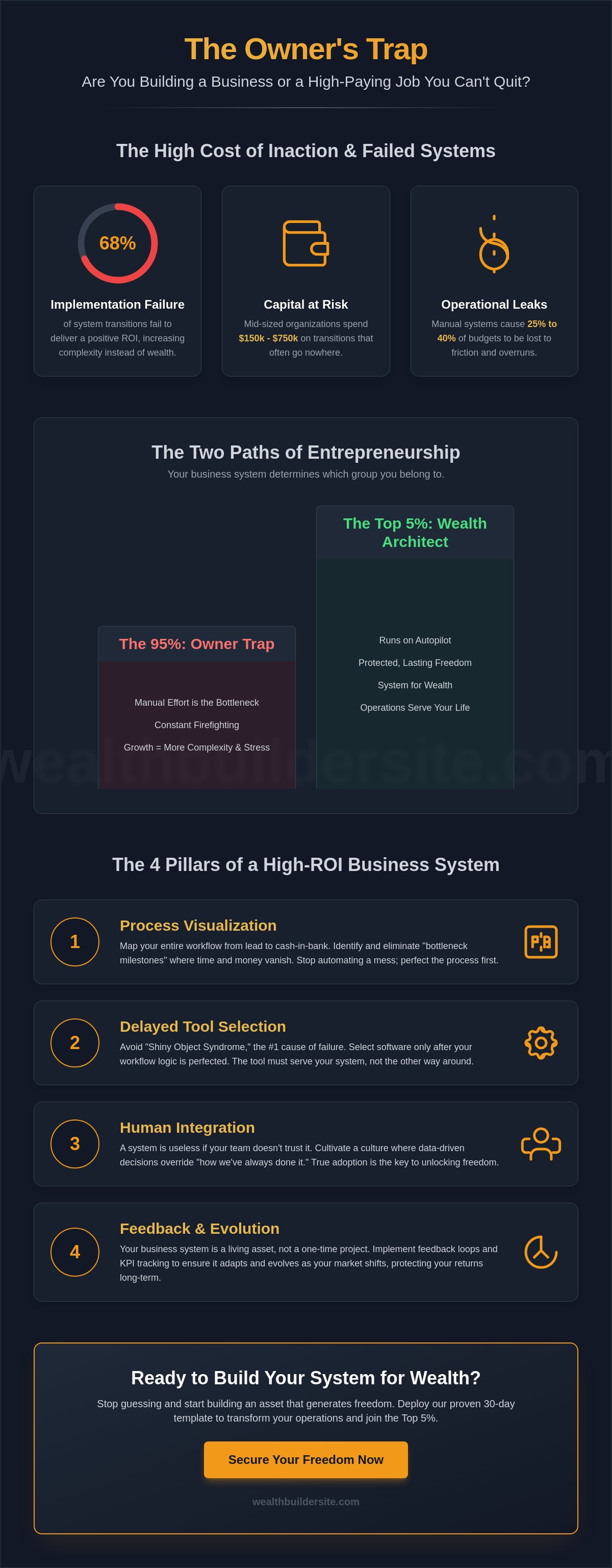
Can I ask you one question? Why are you working harder just to buy yourself less freedom? If you’re currently trapped in a cycle of constant firefighting, you’re likely part of the 68% of leaders whose business system implementation fails to deliver a real return. In 2026, mid-sized organizations spend between $150,000 and $750,000 on these transitions; yet, most end up with more complexity instead of more wealth. Stop guessing and start playing by a different set of rules.
You already feel the weight of growth that demands more expensive staff and more of your personal time. It’s a dangerous game where the stakes are your health and your future. We’re here to help you stop the leak. We promise to provide a proven 30-day template that transforms your operations into a system for wealth. This article previews the exact steps to move into the Top 5% Rank of businesses that run on autopilot, ensuring your hard work results in protected, lasting freedom.
Key Takeaways
- Stop guessing and identify why your manual effort is the primary bottleneck preventing your transition to the Top 5% Rank.
- Master the 4 pillars of high-ROI business system implementation to plug the invisible leaks currently draining your potential returns.
- Deploy a 30-day architecture that prioritizes workflow logic over software so your tech stack serves your wealth instead of your ego.
- Discover why 70% of systems fail and how to bypass the "Shiny Object Syndrome" that costs most business owners their sanity.
- Learn how to align your operations with "God’s Road to Financial Freedom" to move beyond software and secure a lasting legacy.
Stop Guessing: Why Your Hard Work is the Biggest Barrier to Your Wealth
Can I Ask You One Question? Is your business a vehicle for wealth or a high-paying job you can't quit? Most entrepreneurs confuse activity with progress. They believe that more hours equal more returns, but this is the "Owner Trap" in its purest form. If your presence is the only thing keeping the machine running, you haven't built an asset; you've built a cage. You aren't scaling; you're just accelerating toward a hard ceiling where manual effort can no longer sustain the weight of your ambitions.
The numbers don't lie. In 2026, the average cost for a mid-market Enterprise resource planning transition sits between $150,000 and $750,000 for the first year. Despite these high stakes, approximately 68% of these projects fail to meet their primary objectives. This chaos isn't just a headache; it's a massive financial leak. If you're operating in competitive markets like the US or Europe without a structured business system implementation, you're likely losing 25% to 40% of your budget to budget overruns and operational friction. This is the cost of guessing.
The Difference Between a Business and a Job
A wealth-building system is an asset that produces consistent cash flow without your physical presence. It's the difference between being the engine and being the architect. Automation protects your most valuable resource: your time. When you shift from "doing" daily tasks to "designing" operations, you stop being a high-level technician and start being a true owner. You move from the daily grind to a strategic position where your wealth is protected by logic, not just your sweat.
The High Stakes of Inaction
If you don't systemize now, you're actively building a fragile legacy that will crumble the moment you step away. The game already changed. In 2026, manual workflows are no longer just "old school"; they are a competitive disadvantage that leaves you vulnerable to more agile players. Strategic growth requires a foundation that doesn't depend on your personal adrenaline. Accidental survival is a gamble you will eventually lose. Choosing a rigorous business system implementation is the only logical way to secure your spot in the Top 5% Rank of entrepreneurs who actually enjoy the freedom they've earned.
The 4 Pillars of High-ROI Business System Implementation
Can I Ask You One Question? Why are you trying to automate a mess? If you buy the tool before you map the process, you're just paying to fail faster. A successful business system implementation isn't about the tech; it's about the architecture. You need to move away from the "Owner Trap" and into a framework where your wealth is protected by four non-negotiable pillars. First, you need Process Visualization to see the invisible leaks where cash and time vanish. Second, you must delay Tool Selection until your workflow is perfected. Third, you require Human Integration; your team must trust the system over their gut feelings. Finally, you need Feedback Loops to ensure the system evolves as the market shifts. If any of these pillars are missing, your growth will be unsustainable.
Human Integration is often where the best plans go to die. If your staff continues to rely on "how we've always done it," your new system is just an expensive paperweight. You must cultivate a culture that values the system's data over individual intuition. This shift isn't just about training; it's about leadership. It's about showing them that a protected, automated workflow makes their jobs easier and your business more resilient. When the team trusts the machine, you finally achieve the freedom to stop managing and start leading.
Visualizing Your Operations for Maximum Efficiency
If you don't map your process from lead generation to cash in the bank, you're simply guessing. You need to identify "bottleneck milestones", those specific points where work piles up and scalability dies. In 2026, using digital tools for small business to create a visual map is the only way to expose the 30% of functionality that typically goes to waste in unoptimized systems. Most owners ignore these leaks until they've already lost thousands in potential returns. Don't be one of them. Map it, measure it, and then master it to ensure your operations are as lean as your ambitions are large.
To get professional help in mapping these processes and identifying bottleneck milestones, you can discover Business Analysis & Solutions, which offers expert consultancy to drive organisational efficiency.
The Strategic Tool Audit
Stop guessing which software is "best" for your industry. Start asking which one fits your specific architecture. Adopting a Cloud Mindset is essential; it's about choosing tools that are protected, scalable, and user-friendly. If a tool doesn't integrate with your long-term wealth goals, it's just more work. By applying the principles found in Money Mastery, you can ensure your financial systems are built for returns, not just record-keeping. Your tech stack should be a weapon, not a weight. If it doesn't generate a measurable ROI, it has no place in your business system implementation. High-level entrepreneurship requires a disdain for fluff and a commitment to data-backed solutions that actually move the needle on your net worth.
The Implementation Blueprint: Your 30-Day System Deployment Template
Can I Ask You One Question? Do you actually have a plan, or are you just operating on a wish list? Most entrepreneurs fail because they view business system implementation as a vague, long-term goal rather than a high-stakes, timed mission. If you don't set a hard deadline, your operational chaos will simply expand to fill the available time. You need a sprint, not a marathon. We've decoded the process into a 30-day blueprint designed to move you from a stressed technician to a strategic architect who owns a protected asset.
- Days 1-7: The Audit. Stop guessing where your time is leaking. You'll document your "As-Is" state and pinpoint the specific $50K leaks caused by manual errors and redundant tasks.
- Days 8-14: The Architecture. This is where you design the "To-Be" workflow. You select a tech stack that serves your vision, ensuring every tool is scalable and results-oriented.
- Days 15-21: The Integration. You move the data and build the automations. This is the heavy lifting phase where your new machine finally starts to breathe.
- Days 22-30: The Optimization. Test the logic. Train the team. End the month with your first "Off-Grid" day to prove the business no longer requires your adrenaline to survive.
Week 1: Auditing Your Current Chaos
Start by listing the top three processes that consume 80% of your work week. If these tasks aren't directly generating wealth, they're anchors holding you back. You must identify the "non-negotiable" tasks that require immediate business system implementation to preserve your sanity. Don't just list what you do; measure how long it takes. Set measurable milestones for this week to ensure you're actually building a foundation instead of just rearranging the mess. Precision is the only way to reach the Top 5% Rank.
Weeks 3-4: Training and Live Deployment
You can't lead a transformation if your team is secretly rooting for the old ways. Secure immediate buy-in by showing them the "What's in it for me?" factor. If the system eliminates five hours of soul-crushing data entry, they'll become its fiercest protectors. Use a "Shadow Phase" where the new system runs alongside the old for seven days. This overlap is critical; it's the safety net that prevents the common pitfalls detailed in research on why transformation efforts fail. Finish the month by finalizing your process visualization so every team member understands the new rules of the game.
Avoiding the Implementation Trap: Why 70% of Systems Fail
Can I Ask You One Question? Why are you surprised when your expensive new software fails to fix your broken habits? Most entrepreneurs treat a business system implementation as a one-time purchase rather than a leadership milestone. The research is clear; around 60% to 70% of these projects are expected to fail in 2026. This isn't because the technology is flawed. It's because the owner is distracted. If you want to move into the Top 5% Rank, you must stop guessing and start identifying the traps that turn high-level strategies into expensive paperweights.
Trap #1 is "Shiny Object Syndrome." You don't need more tools; you need better logic. Over-complicating your tech stack leads to "Zombie Systems" where up to 30% of planned functionality is never used, yet you still pay the subscription fees. Trap #2 is a lack of leadership. A system is only as good as the owner's commitment to enforce it. If you allow your team to bypass the new workflow, you're actively sabotaging your own returns. Trap #3 is neglecting data migration. Garbage in, garbage out. If your data is 20% inaccurate, your automation becomes 100% useless. Finally, Trap #4 is resistance to change. Whether you are leading a Dortmund startup or a US office, human friction is the ultimate bottleneck.
The Psychology of System Success
Successful automation requires you to overcome the deep-seated fear of losing control. You've spent years being the "firefighter," and your ego might actually enjoy being the only one with the answers. You must kill that version of yourself to survive. "Stop Guessing" must become your team's new mantra. You aren't losing control; you are gaining precision. Build a culture where effort is secondary to accuracy. If your team values "staying busy" over "following the system," your wealth will never be protected.
Technical Pitfalls to Sidestep
Ensure your business automation software actually talks to your CRM before you go live. Siloed data is the enemy of a scalable business system implementation. You must follow a strict 3-faze testing rule: test the logic, test the data, and then test the user experience. This prevents budget overruns, which typically exceed initial quotes by 25% to 40%. Don't let your business become a statistic of poor planning. If you’re ready to bypass these traps and secure your legacy, apply for WealthBuilders Coaching to get direct guidance from those who have already won the game.
Beyond the Software: Building Lasting Wealth with WealthBuilders University
Can I Ask You One Question? Do you want a business that works, or a life that thrives? A successful business system implementation is just the ticket to the game; it isn't the trophy. If you stop at automation, you've only built a faster treadmill. True success means moving beyond the "Owner Trap" and onto God's Road to Financial Freedom. This is where your systemized income stops being a paycheck and starts being a seed for a diversified wealth portfolio that generates returns while you sleep.
We've seen this transformation firsthand. Entrepreneurs in Dortmund and across the US have used these exact blueprints to reclaim 20+ hours of their week. That's over 1,040 hours a year returned to your control. What would you do with that time? Most of our members use it to master our Real Estate Workshop or join elite coaching circles. They've stopped being technicians. They've become strategic insiders who have already decoded the complexities of the market and refuse to play by the old rules of "hustle culture."
The WealthBuilders Advantage
WealthBuilders University isn't just another online course. It's a high-stakes curriculum designed to combine tactical business automation with biblical financial principles. For a Premium Monthly subscription of $29.95, you gain access to a global community of leaders who refuse to settle for stagnation. Once your business system implementation is stable, your next milestone is leveraging that cash flow for passive returns. Whether it's through our Business Workshop or the annual WealthBuilders Conference, we provide the curated, proven solutions you need to protect your future and build lasting wealth.
Your Next High-Stakes Move
Stop guessing about when you'll finally be "ready" to scale. The game already changed. If you wait for the "perfect" time, you're just choosing to fall behind. You have the blueprint. You know the costs of inaction, which regularly exceed $150,000 for mid-market firms that fail to plan. Now, you need the community and the curriculum to ensure your systems generate wealth, not just more work. It's time to choose between accidental survival and strategic growth. Join WealthBuilders University and Systemize Your Success today.
Stop Building a Cage and Start Securing Your Wealth
Can I ask you one question? If you walked away from your desk today, would your bank account continue to grow or would your operations collapse by sunset? You've seen the data. You know that a failed business system implementation is a $150,000 mistake that most entrepreneurs never recover from. You have the 30-day blueprint. You understand the four pillars of a protected asset. The only thing left is to decide if you belong in the Top 5% Rank or the exhausted 95%.
Stop guessing about your future. Our members achieve $50K+ average savings through optimization and Red Dot level strategic design. You don't have to reinvent the wheel when you have access to Billy Epperhart's proven wealth systems. If you're ready to stop trading your life for a high-paying job you can't quit, the path is clear. Take the First Step Toward Freedom—Join WealthBuilders University Today. Your legacy is protected by the systems you build today, not the effort you exert tomorrow. It's time to win the game.
Frequently Asked Questions
How long does a typical business system implementation take?
A standard business system implementation follows our 30-day blueprint; however, complex ERP deployments for mid-sized firms can span 6 to 12 months. If you don't stick to a hard timeline, you risk joining the 68% of projects that fail to meet their primary objectives. Precision is your only protection against the 25% budget overruns that plague unmanaged transitions.
Do I need to hire a full-time IT person to manage these systems?
You don't need a full-time IT hire if you adopt a cloud-first mindset and modular tools. In 2026, cloud ERP platforms typically cost between $50 and $200 per user monthly, which is a fraction of a specialist's salary. Your goal is to be the architect who designs the workflow, not the technician who fixes the hardware.
What are the best business automation tools for a small service business?
The best tools are modular, API-first solutions that allow you to scale without overhauling your entire infrastructure. For a small service business, a successful implementation usually costs between $10,000 and $80,000. Stop guessing which "shiny object" is best and choose tools that integrate with your CRM to prevent the "Zombie System" trap.
Can I implement these systems if I'm a solopreneur in Dortmund?
You absolutely can and should implement these systems as a solopreneur to stop trading time for money. Reclaiming 20 hours a week is the standard milestone for our members who follow the WealthBuilders curriculum. If you're in Dortmund or any competitive market, automation is the only way to move from accidental survival to a Top 5% Rank.
What is the expected ROI of a successful system implementation?
A successful business system implementation generates a measurable ROI by plugging the invisible leaks that cost the average business thousands in lost productivity. Our members frequently see $50,000 or more in savings within the first year of optimization. Beyond the cash, the real return is the time freedom required to build a diversified wealth portfolio.
How do I know which process to automate first?
You must automate the "non-negotiable" tasks that consume 80% of your time first. These are usually the repetitive administrative burdens that prevent you from focusing on strategic growth. If a process requires you to "firefight" daily, it's a primary candidate for systemization to protect your sanity and your returns.
Is WealthBuilders University right for a business that isn't profitable yet?
WealthBuilders University is designed for those ready to stop guessing, regardless of their current profit margins. For just $29.95 a month, you get the curriculum needed to transform a high-paying job into a wealth-generating asset. If you aren't profitable yet, it's likely because you're playing by old rules that prioritize effort over systems.
What happens if my team resists the new systems?
Team resistance is a leadership milestone that you must navigate with "tough love" and clear logic. If 70% of systems fail due to human friction, you cannot afford to be passive. Show them the "What's in it for me?" factor, such as reduced soul-crushing data entry, to secure the buy-in necessary for a protected legacy.