
Are you building an asset, or are you just the most overworked employee in a company you happen to own? If your presence is the only thing keeping the lights on, you don't have a business; you have a high-stakes job with terrible benefits. You likely believe that more sweat is the only way to survive an economy where operating costs are up for 75.6% of owners. This business building guide is designed to challenge that exhaustion-based logic and provide a clear exit from the daily grind.
It's time to stop building a job and start building a machine with a systematic roadmap to scalable wealth. With cash flow surpassing inflation as the primary concern for 31% of entrepreneurs in 2026, you can't afford to manage by intuition anymore. If you continue to rely on manual effort, you'll eventually hit a ceiling that breaks you. This article provides the blueprint to transition from operational chaos to a system of repeatable processes. We will explore why the right methodologies beat raw hustle every time and how to engineer a company that thrives without your constant intervention.
Key Takeaways
- Stop confusing self-employment with business ownership and learn why trading your time for money is a mathematical dead end.
- Identify the four non-negotiable pillars of a scalable system to ensure your company generates results without your constant intervention.
- Use this business building guide to replace static, 50-page plans with dynamic workflows that actually drive wealth and operational stability.
- Audit your daily schedule to eliminate low-value tasks and map a value chain that turns total strangers into lifelong advocates.
- Recognize when self-study hits a ceiling and how a structured curriculum like WealthBuilders University provides the shortcut to elite-level growth.
Why Your Current Business is a Prison (And How to Build an Escape Hatch)
If you stop working right now, does the revenue stop flowing? If the answer is yes, you haven't built a business. You've built a high-pressure prison where you are both the inmate and the warden. Most people who call themselves entrepreneurs are actually just self-employed workers who own their own stress. They are stuck in the "Time-for-Money" trap, a model where income is directly tied to personal output. This is a mathematical dead end. You only have 24 hours in a day, which means your wealth has a hard, unbreakable ceiling as long as you are the primary engine of production.
The 2026 market reality is brutal for those who refuse to adapt. With operating costs rising for 75.6% of small business owners, thin margins can no longer absorb the cost of human error or manual inefficiency. If your company isn't automated, it's already obsolete. A true business building guide is not a collection of vague "hustle" tips. It is a technical blueprint for creating a self-sustaining asset. It is the difference between owning a job and owning a machine that prints money while you sleep.
The High Cost of Stagnation
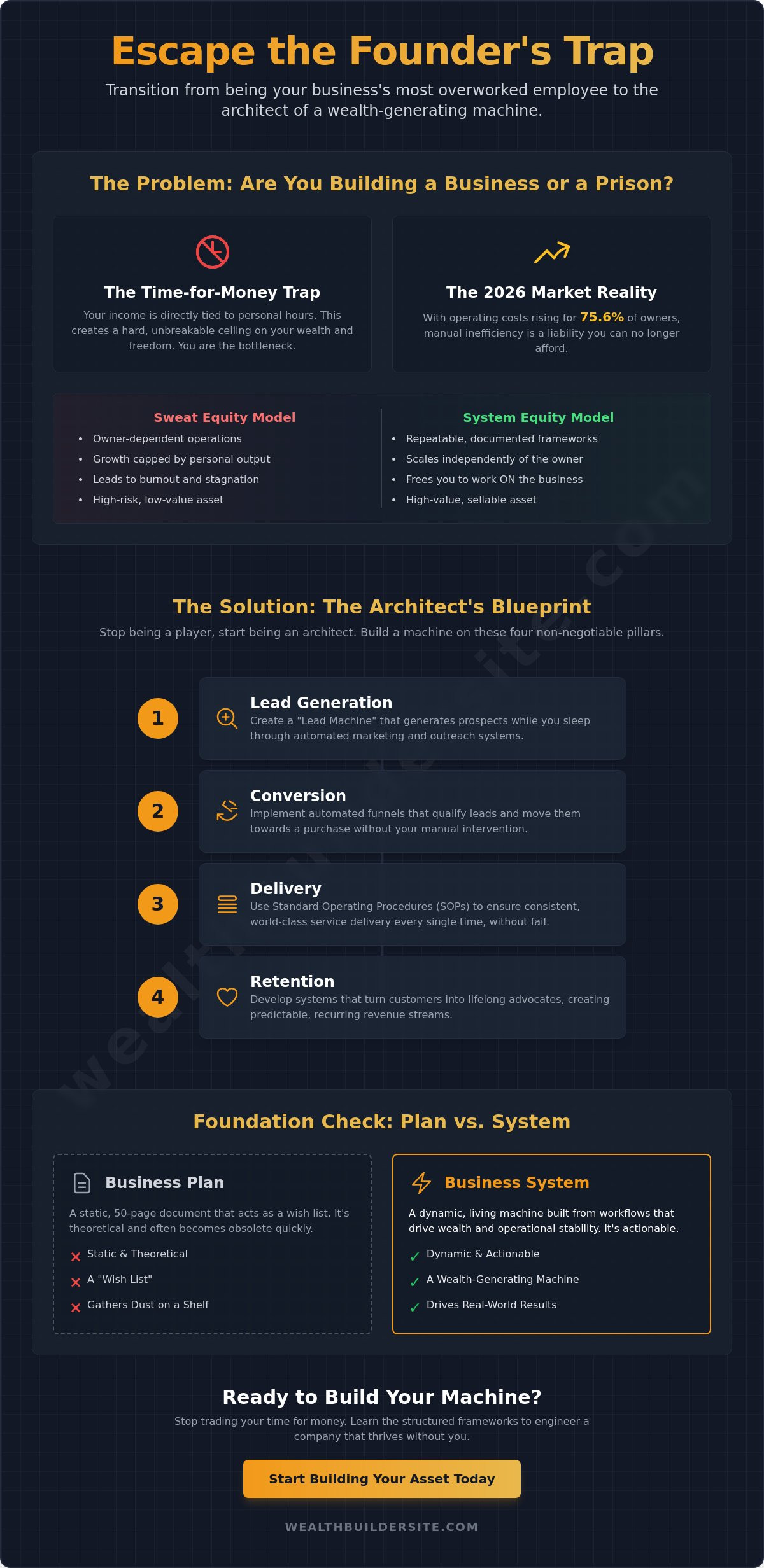
Most founders eventually hit a "Founder’s Ceiling." This is the psychological and operational point where growth stops because you have become the bottleneck. Every decision, every email, and every crisis must pass through you. This "Sweat Equity" model is a liability. In contrast, the "System Equity" model focuses on building value through repeatable frameworks. Ask yourself this: if you took a 30-day holiday today with no phone access, would your business survive? If the answer is no, you don't own an asset; you own a ticking time bomb of burnout.
Shifting from Worker to Architect
The most successful Dortmund entrepreneurs aren't the ones working the longest hours. They are the ones who spend their time working ON the business instead of IN it. This shift requires you to stop "doing" and start "designing." You must become an architect of workflows. By implementing rigorous business process management, you ensure that every task is documented and optimized. This isn't just about being organized. It's about WealthBuilding through operational efficiency. When the machine runs itself, you are finally free to scale your vision rather than your workload.
The Architect’s Blueprint: 4 Pillars of a Scalable Business System
A business plan is just a wish list. A system is a machine. If you want to win the game of entrepreneurship in 2026, you must stop acting like a player and start acting like the architect. You aren't an entrepreneur until you have a blueprint that functions without your direct labor. You cannot scale a mess. To move from a chaotic startup to a high-performance asset, you must build on four non-negotiable pillars: Lead Generation, Conversion, Delivery, and Retention. These are the gears of your engine. If one gear slips, the entire machine grinds to a halt. This business building guide isn't about working harder; it's about engineering a structure that supports massive weight without cracking.
Before you can automate, you must document. You can't code a process that only exists in your head. Standard Operating Procedures (SOPs) are the DNA of your company. They provide the consistency required to deliver a world-class experience every single time. Without them, you're stuck in a loop of fixing things that shouldn't be broken. When your systems are documented, your business becomes sellable. It stops being a reflection of your personality and starts being an objective asset with a measurable value. If you're serious about learning How to Scale a Business, you must accept that your primary job is to build a machine that eventually makes you obsolete.
Marketing and Sales Automation
Your business needs a heartbeat. That heartbeat is a "Lead Machine" that generates prospects while you sleep. In 2026, relying on manual outreach or referrals is a recipe for inconsistent cash flow. You need automated conversion funnels that qualify leads and move them toward a purchase without your intervention. If you're still manually chasing every prospect, you're losing the competitive war. Utilizing the right business automation software allows you to step away from the front lines and focus on high-level strategy.
Operational and Fulfillment Systems
The "Delivery Engine" is where most businesses fail. They can sell the dream, but they can't fulfill it without the founder working 80 hours a week. You must design a system where quality is a byproduct of the process, not your personal effort. Use digital tools to track performance metrics in real-time. If you don't know your numbers, you don't know your business. This level of control is what we focus on in our Business Workshop. This business building guide is your roadmap to that transition. Mastering your operations leads directly to Money Mastery, the final pillar where your capital begins to work harder than you do. This is the only path to true financial freedom.
Business Plan vs. Business System: Choosing Your Foundation
Why are you wasting 40 hours writing a 50-page document that no one will ever read? If you think a leather-bound business plan is your ticket to success, you're still playing the amateur's game. Traditional plans are static, frozen in time, and usually written to appease a banker who doesn't understand your vision. A business system, however, is a living, breathing machine. While a plan describes what you hope will happen, a system dictates what actually happens every single day. If your foundation is a stack of paper rather than a series of optimized workflows, you aren't building an asset; you're writing a work of fiction. This business building guide focuses on the mechanics of freedom, not the aesthetics of paperwork.
You might use a plan to secure funding, but you use a system to secure your freedom. A 50-page document won't save you when your lead generation dries up or your fulfillment team misses a deadline. The "Lean Startup" approach might help you launch, but the WealthBuilder systematic approach is what helps you scale without burning out. One is about survival; the other is about dominance. If you want to build a wealth-generating engine, you must stop prioritizing the "plan" and start obsessing over the "process."
The Fallacy of the Traditional Plan
Most plans are written for outsiders, not for the entrepreneurs running the show. This leads to "Planning Paralysis," where you spend so much time analyzing the market that you miss the opportunity to capture it. In competitive markets like Dortmund, where new business applications rose by 2.1% in April 2026, speed is a weapon. You don't have time for a 30-page academic exercise. You need a framework that prioritizes cash flow over net worth. It's a core WealthBuilders principle: net worth is a vanity metric, but cash flow is the lifeblood of a scalable machine. If your plan doesn't solve for consistent, daily cash flow, it's a liability.
Building the "Living" Business System
A "living" system starts with a visual map of your business processes. You need to see how a customer moves from a stranger to an advocate. If you can't draw it, you can't manage it. Your design must include feedback loops that allow the system to self-correct without your intervention. This is the shift from being a "doer" to being a "designer." Transitioning to this level of sophistication requires more than just a few tips; it requires a complete mental overhaul. This is exactly why we created WealthBuilders University. It serves as the definitive curriculum for entrepreneurs ready to trade their 60-hour work weeks for a systematic roadmap to wealth.
The 5-Step Execution Guide: Building Your Wealth-Generating Machine
Execution is where most founders fail. They have the vision, but they lack the discipline to build the machine that realizes it. If you're still operating on "hustle and hope," you're gambling with your future. A business building guide is useless if it stays in your head. You must translate these concepts into a series of aggressive, tactical actions. This isn't about working harder; it's about working with surgical precision. To build a system that generates wealth independently of your effort, you must follow a strict execution sequence. Stop being the engine and start being the engineer.
- Step 1: Audit your time. Identify every "Low-Value" task that clogs your schedule. If a task doesn't directly drive revenue or system growth, it must be eliminated or outsourced.
- Step 2: Map the "Value Chain." Document exactly how a customer goes from being a total stranger to a raving advocate. Visualizing this journey reveals where you're losing money.
- Step 3: Document the "Critical Path." Create a step-by-step manual for every major operation. If your team can't replicate your results without calling you, the system is broken.
- Step 4: Implement automation. Use technology to replace manual labor. In May 2026, 58% of small businesses reported using AI with positive results. If you aren't one of them, you're falling behind.
- Step 5: Delegate and Manage by Metrics. Move from managing people to managing dashboards. Your presence should be a choice, not a requirement for survival.
Auditing and Mapping
Eighty percent of your profit is generated by twenty percent of your activities; the rest is just expensive noise. You must identify the "Single Point of Failure" in your current model. Most of the time, that failure point is you. Use process visualization tools like flowcharts or Trello to see the friction in your workflows. If you can't draw the process, you don't own it. Mapping the Value Chain allows you to see exactly where human intervention is slowing down your scaling potential.
Automation and Delegation
Selecting the right tech stack is the difference between a leaner business and a bloated one. You don't need more employees; you need better systems. When you do hire, hire for systems rather than just tasks. You want people who can run the machine, not people who require you to be the machine. Use a "Trust but Verify" model of management. Dashboards should give you real-time data on performance so you don't have to hover. If you're ready to stop being a slave to your own company, apply for WealthBuilders Coaching to get the elite-level frameworks you need to exit the daily grind.
Beyond the Guide: Scaling with WealthBuilders University
How much longer are you willing to wait for the success you claim to want? Reading a business building guide is the first step, but information without implementation is just expensive entertainment. In the high-stakes world of 2026, where 93% of small businesses expect to grow but only a fraction actually achieve it, self-study is a slow death. You don't have time to learn by trial and error while your competitors are already using data-backed frameworks to outpace you. You need a structured curriculum that moves you from a state of chaos to a state of total control. If you continue to rely on your own intuition, you'll remain the bottleneck that prevents your company from reaching its true potential.
The transition from a struggling founder to a strategic architect requires more than just "hustle." It requires an insider tactical approach that the average business owner never discovers. We've seen this transformation happen repeatedly right here in Dortmund. Local entrepreneurs who were once slaves to their own companies have used our systems to reclaim their time and secure their legacies. One Ruhr region founder recently reduced their personal workload by 40 hours a week while increasing revenue by 15% within six months of attending our Business Workshop. This isn't magic. It's the result of replacing sweat with systems.
The WealthBuilders Advantage
Our Business Workshop and Money Mastery programs aren't just classes; they're tactical interventions. They provide the specific, quantified proof points you need to manage by metrics rather than presence. Why spend five years struggling to figure out the market when a seasoned mentor can give you the shortcut to elite status in five months? A mentor is the ultimate weapon in a competitive environment. Moving from a worker to a true WealthBuilder requires a radical commitment to precision. It means choosing the security of proven solutions over the uncertainty of unverified methods. If you're ready to lead a transformation, you must be willing to follow a roadmap that has already been decoded by those at the top.
Your Next Strategic Move
If you're done trading your life force for a paycheck, your path is finally clear. You can continue to grind until you burn out, or you can choose to scale your vision. The WealthBuilders Conference offers the perfect environment for high-level networking with local leaders who have already mastered these frameworks. This is where the elite gather to sharpen their tactics and protect their wealth. If you're ready to fast-track your results and stop being a slave to your own company, Apply for WealthBuilders Coaching today. This is your exit from the cycle of exhaustion. Stop building a job. Start building a machine. Your legacy depends on the systems you build today.
Build the Machine or Remain the Fuel
Will you continue to be the engine that powers your business, or will you become the engineer who owns it? If you choose to keep trading your life force for revenue, you're accepting a future of inevitable burnout. You've seen the blueprint for the four essential pillars and the five-step execution sequence. This business building guide is your exit strategy from operational chaos. It's time to stop acting like a worker and start thinking like an architect of wealth. If your company can't function without you, it's a liability, not an asset.
You don't have to decode the market by yourself. Access seasoned mentors with proven, data-backed frameworks and a comprehensive curriculum that covers everything from automation to real estate. Join an active community of high-level entrepreneurs who have already made the shift. Join WealthBuilders University and Start Building Your Machine. Your legacy is waiting for the systems you build today. Take the shortcut to elite status and secure your financial freedom now.
Frequently Asked Questions
What is the most important part of a business building guide?
The most critical component of a business building guide is the transition from manual labor to systematic design. If you don't prioritize building a repeatable machine over your own personal hustle, you're just creating a high-pressure job for yourself. You must focus on documenting the four pillars of lead generation, conversion, delivery, and retention to ensure the business survives your absence.
How long does it take to systemize a small business?
You can typically systemize the core operations of a small business within 90 days if you follow a rigorous execution sequence. While total automation is an ongoing process, the initial audit and mapping of your value chain should be completed quickly to stop the bleed of your time. If you take longer than a quarter to implement basic workflows, you risk falling behind competitors who are already optimizing for efficiency.
Can I build a business system without being a tech expert?
You don't need to be a tech expert to build a high-performance business system. Modern automation relies on logic and process mapping rather than complex coding. If you can draw a flowchart of how a customer moves from a lead to a sale, you can use existing software to handle the heavy lifting. The real challenge isn't the technology; it's the discipline to stop doing the work yourself.
Why do most business plans fail within the first year?
Most traditional business plans fail because they are static documents that ignore the daily friction of a live market. They often focus on vanity metrics and academic projections rather than the living systems required to manage cash flow. If your plan doesn't include a dynamic roadmap for lead generation and fulfillment, it's just a work of fiction that will break the moment it hits reality.
Is business automation expensive for a startup in Dortmund?
Business automation is an essential investment for Dortmund startups facing the 2026 reality of rising operating costs. With 75.6% of business owners reporting higher expenses than last year, the cost of manual labor is far higher than the cost of a lean tech stack. Automating your workflows is the only way to protect your margins and ensure your company remains competitive in a tightening local market.
What is the difference between a business coach and a business mentor?
A business coach typically focuses on asking you questions to find your own answers, while a business mentor provides the proven blueprint they've already used to win. At WealthBuilders, we don't just want to talk about your feelings; we want to give you the tactical approach required to dominate your industry. A mentor is an insider who has already decoded the market and offers you a shortcut to elite status.
How do I know when it is time to scale my business?
You know it's time to scale when your delivery engine produces consistent, high-quality results without your direct intervention. If you attempt to scale a business that still relies on your personal sweat equity, you'll only scale your own burnout. Scale is a reward for building a machine that functions independently, not a solution for a broken or manual model.
Can any business model be automated for passive income?
While most business models can be heavily automated, the idea of passive income is often a trap for the unprepared. You can build a system that generates wealth while you sleep, but every machine requires an architect to monitor the metrics and optimize the performance. If you want a self-sustaining asset, you must first commit to the hard work of designing the workflows that make passive results possible.