
Are you building a legacy, or did you accidentally buy yourself a 40-hour work week disguised as passive income? If you're still chasing tenants and manually updating fragmented spreadsheets while the 30-year fixed mortgage rate sits at 6.70%, you aren't an investor; you're an employee of your own equity. Most landlords fail to scale because they lack professional real estate investment systems that treat property as inventory rather than a hobby. If you don't master the rules of the system, you're just a pawn in the market's game, vulnerable to every shift in the economy.
It's time to admit that trading your limited hours for rental checks isn't the freedom you were promised. You want your capital to work for you, not the other way around. You'll discover how to implement a scalable investment engine that provides clear financial visibility and income that actually feels passive. We'll break down how to leverage the permanent 100% bonus depreciation and automated workflows to move from an exhausted landlord to a high-level strategic wealth builder.
Key Takeaways
- Identify the structural difference between a "hobbyist" landlord and a systematized institutional investor to stop trading your life for rent checks.
- Implement real estate investment systems that automate your lead funnel and replace emotional guesswork with a cold, data-backed analysis framework.
- Quantify the financial impact of your manual bottlenecks by calculating your specific "Time-Freedom" metric per unit.
- Execute a 5-step implementation plan to audit your current operations and establish a "Buy Box" that makes scaling an inevitability.
- Bridge the gap between software and strategy by aligning your wealth-building engine with Kingdom-driven principles for lasting impact.
The 'Accidental Landlord' Trap: Why Most Investors Never Scale
Are you actually an investor, or are you just a high-paid property manager for your own assets? Most people stumble into real estate investing with dreams of passive income, only to find themselves trapped in a cycle of manual labor and frantic problem-solving. They buy a property, manage it with a spreadsheet, and call it a business. That isn't a business; it's a "hobbyist" trap. True real estate investment systems are repeatable operational frameworks that remove the individual from the equation. If your strategy depends on your personal bandwidth, you'll hit a ceiling long before you reach your financial goals.
Institutional investors don't "check in" on properties. They deploy systems. While the hobbyist is busy haggling with contractors or manually tracking a $398,000 median home price acquisition, the systematized investor is reviewing dashboards. You must decide if you want a portfolio that serves your life or a portfolio that consumes it. Financial freedom is merely the ability to pay your bills. Wealth freedom is the ability to walk away from the machine and know it'll keep producing without you. If you're still the primary engine of your portfolio, you're at risk of stalling out.
The High Cost of Manual Management
Every minute you spend digging through fragmented email chains or re-keying data into a spreadsheet is a minute you aren't finding the next deal. This is the "hidden" tax of manual management. It leads directly to analysis paralysis. If you spend three days vetting a property while the 30-year fixed mortgage rate fluctuates between 6.49% and 6.70%, you've already lost your competitive edge. Use this simple test: if you can't take a month off to focus on your family or your health without your portfolio stagnating, you don't have a system. You have a second job.
Systems as the Ultimate Risk Mitigation
Standardized workflows aren't just about efficiency; they're about protection. They prevent expensive surprises by ensuring every inspection, lease renewal, and maintenance request follows a proven protocol. By removing emotional bias from acquisitions, you stop making "gut" decisions that lead to buyer's remorse. You need a data-backed framework that tells you "Go" or "No-Go" based on cold metrics, not a temporary feeling. A system is the bridge between capital and cash flow.
The Anatomy of a High-Performance Real Estate Investment System
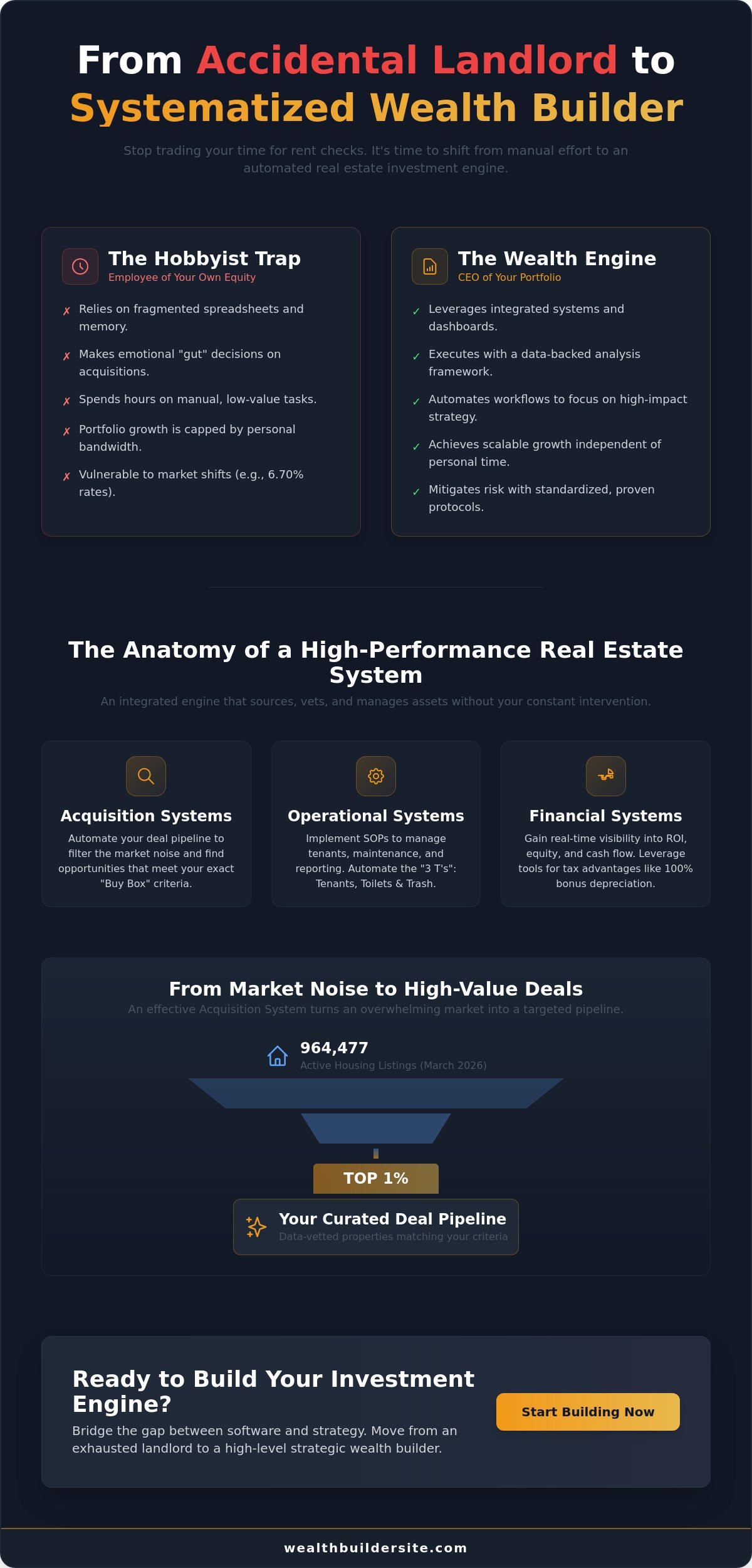
Do you have a strategy, or are you just playing a high-stakes game of whack-a-mole? A high-performance investment system isn't a single piece of software. It's an integrated engine that sources, vets, and manages assets without your constant intervention. If you're still manually scrolling through listing sites at midnight, you don't have a system. You have a habit. Professional real estate investment systems are built on four critical pillars that transform your capital into a self-sustaining wealth machine.
The transition from a hobbyist to a mogul requires a shift in how you view data. With the median existing home price sitting at $398,000 as of early 2026, the margin for error has never been thinner. You can't afford to guess. You need a financial reporting loop that provides real-time visibility into your ROI and equity growth. If you don't know your exact numbers at any given moment, you aren't managing an investment. You're managing a mystery.
Acquisition Systems: Finding the Needle in the Haystack
Building a deal pipeline means you never have to "look" for a deal again. It means the deals find you. By implementing automated lead scoring, you can filter through the 964,477 active housing listings reported in March 2026 and focus only on the top 1% that meet your criteria. While individual investors struggle with manual entry, professionals utilize CRM tools to manage relationships with brokers and wholesalers. This level of structure is what separates a solo landlord from the sophisticated approach seen in Real Estate Investment Trusts (REITs). If you aren't building a pipeline, you're just waiting for luck to strike.
Operational Systems: Protecting Your Most Valuable Asset
Once the deal is closed, the system must take over. Standard Operating Procedures (SOPs) for tenant onboarding and maintenance aren't just paperwork. They're your defense against chaos. If you're still taking calls about leaky faucets, you've failed to outsource the "three Ts": Tenants, Toilets, and Trash. Integrating property management software with your accounting systems ensures that rent collection and late-fee triggers happen automatically. This protects your cash flow and frees your mind to focus on high-level growth. If you want to master these frameworks, joining WealthBuilders University is the next logical step for your professional evolution.
Your analysis framework must be cold and calculated. With 30-year fixed mortgage rates hovering between 6.49% and 6.70%, your system should instantly determine if a property yields the necessary spread. If the raw data doesn't trigger a "Go" decision within your pre-defined parameters, you walk away. No emotions. No "potential." Just profit. This is how you protect your time and your legacy.
Manual vs. Automated: Calculating the Real ROI of Systems
How much is your hour actually worth? If you're still manually auditing bank statements to verify rent payments, you're valuing your time at a minimum-wage rate. High-level real estate investment systems don't just organize your data; they buy back your life. Consider the "Time-Freedom" metric. If manual management consumes five hours per unit each month, a ten-unit portfolio becomes a part-time job. At thirty units, it's a prison. Automated systems reduce that administrative load by up to 80%, allowing you to scale without sacrificing your sanity or your primary income source.
Scaling is where the "hobbyist" hits a wall. Most manual systems break at three units because the human brain isn't wired to track thirty separate maintenance cycles, tax deadlines, and lease expirations simultaneously. As noted by successful real estate investors, mastering the operational side is a non-negotiable skill for those moving beyond the basics. If you can't manage thirty units with the same effort you use for three, your foundation is flawed. You aren't building a legacy; you're building a bottleneck.
The Spreadsheet Bottleneck
Excel is the silent killer of your growth. It's a static tool in a dynamic market. When you're making a high-stakes decision about a 1031 exchange or a cash-out refinance, you can't rely on stale data from last month's manual entry. Fragmented systems lead to missed tax deductions, especially with the 100% bonus depreciation restored under the One Big Beautiful Bill Act of 2025. One missed receipt or a forgotten expense category could cost you thousands in unrecaptured Section 1250 gain at the flat 25% federal tax rate. You aren't saving money by doing it yourself; you're hemorrhaging it through technical debt and inefficiency.
The Automation Advantage
True leverage comes from trigger-based workflows. What happens when a lease is 60 days from expiring? In an automated system, the renewal offer is sent, the market rent is analyzed against current trends, and the property manager is alerted without you lifting a finger. This provides the psychological peace of mind required to play the long game. You can view your net worth and cash flow at a glance through a real-time dashboard, ensuring you're always ready for the next move. To see how these frameworks integrate into a broader strategy, consult our property investment guide on building systems instead of just portfolios.
If you don't automate the mundane, you'll never have the bandwidth for the magnificent. The goal isn't just to own property. The goal is to own an "investment engine" that produces results regardless of your physical presence. Stop being the mechanic and start being the pilot.
How to Build Your Investment Engine: A 5-Step Implementation Plan
If you treat your portfolio as a series of chores, you'll never own a business. You'll simply own a collection of liabilities that demand your attention. Transitioning to professional real estate investment systems requires a cold, clinical approach to your operations. If you aren't willing to dismantle your current "hobbyist" habits, you're choosing to stay small. Success isn't about working harder; it's about building a machine that works regardless of your input. Follow this 5-step blueprint to install a scalable investment engine.
- Step 1: Audit your time-leaks. Track every minute spent on property-related tasks. If you're spending hours on manual data entry or fragmented communication, you've identified a bottleneck that must be automated or outsourced.
- Step 2: Define your 'Buy Box.' Establish rigid criteria for every acquisition. If a deal doesn't hit your specific thresholds for Cap Rate or Cash-on-Cash return, it's an immediate rejection.
- Step 3: Select your 'Core Four.' Identify the Agent, Lender, Contractor, and Property Manager who prioritize systemic growth over one-off transactions.
- Step 4: Document your SOPs. If a task is recurring, it needs a Standard Operating Procedure. If the process only exists in your head, it's a liability to your scale.
- Step 5: Stress-test the system. Run "What-If" scenarios. How does your cash flow hold up if the 30-year fixed mortgage rate climbs toward the 6.70% mark? What happens if the "21st Century ROAD to Housing Act" passes the Senate and shifts the competitive landscape?
Defining Your Buy Box
Automation begins with the power of "No." A rigid Buy Box is your first line of defense against emotional investing. By establishing non-negotiable thresholds for IRR and debt coverage ratios, you automate the rejection of 99% of bad deals. This saves your mental energy for the 1% that actually move the needle. When the median existing home price is $398,000, you can't afford to let a "maybe" deal clog up your pipeline. If you're ready to master these high-level acquisition strategies, register for our next Real Estate Workshop to learn the frameworks used by elite investors.
Assembling the 'Core Four'
You aren't a solo player; you're the CEO of an investment firm. Your team must understand that they are part of a larger system. When vetting partners, look for those who use integrated communication platforms rather than endless text threads. Your Agent should provide data-backed opportunities, not just listings. Your Lender should understand your long-term scaling goals, not just the current closing. If your team doesn't fit into your real estate investment systems, they're slowing you down. Integrate them into a centralized workflow where updates are seamless and accountability is absolute.
Scaling Beyond the Basics: The WealthBuilders Framework
Buying a subscription to property management software doesn't mean you have a system. It means you have a tool. A hammer is useless without the blueprint and the skill to swing it. To truly dominate the market, you must move beyond the technical and adopt the WealthBuilders mindset. This is where professional real estate investment systems intersect with high-level strategy and purposeful vision. If your portfolio exists only to stack cash, you'll eventually lose the motivation to maintain the machine. You need a framework that aligns your financial growth with Kingdom-driven principles to ensure your legacy has actual substance.
While the 30-year fixed mortgage rate hovers at 6.70% and the median home price stays near $398,000, "insider" shortcuts become your most valuable asset. Data tells you what happened yesterday. Strategy tells you what to do tomorrow. You've already learned how to audit your time and assemble a team, but sustainment requires more than a checklist. It requires an environment of excellence. If you're ready to audit your current trajectory, evaluate your plan through our real estate workshop before you commit another dollar to a flawed strategy.
WealthBuilders University: The Curriculum for Freedom
Information is cheap. Execution is expensive. Most investors fail because they spend years in "learning mode" without ever pulling the trigger on a scalable framework. WealthBuilders University bridges this gap by moving you from theory to tactical application within a community of like-minded professionals. It's about more than just numbers; it's about the collective intelligence of investors who refuse to settle for a second job. WealthBuilders University provides the precise blueprints you need to install these systems and reclaim your schedule.
Elite Coaching for Strategic Transformation
There comes a point where self-guided systems hit a plateau. You can only see the obstacles within your own line of sight. This is where WealthBuilders Coaching becomes the catalyst for your next level of growth. Accountability is the fuel that keeps your investment engine running at peak performance. A mentor doesn't just give you data; they provide the perspective to navigate shifting regulations like the "21st Century ROAD to Housing Act" or the complexities of the 2026 tax landscape. Are you ready to stop working for your properties and start making them work for you? The transition from accidental landlord to strategic wealth builder starts with the decision to stop doing it alone.
Stop Playing Small and Start Building Your Legacy
Will you continue to be the bottleneck in your own business? The choice is simple. You can keep chasing receipts and managing chaos, or you can install a machine that produces wealth while you sleep. You now understand that scaling requires a rigid Buy Box and a "Core Four" team that prioritizes systemic growth over simple transactions. If you don't build a machine, you are the machine.
Professional real estate investment systems are the only way to bridge the gap between accidental landlording and strategic empire building. It's time to leverage proven frameworks for Kingdom-driven wealth and gain access to a partner network that has already decoded the market's complexities. Through comprehensive coaching from seasoned investment insiders, you can finally move from a state of doubt to a state of absolute readiness.
Build your scalable investment engine at WealthBuilders University and stop trading your limited hours for rental checks. Your future self is waiting for you to lead this transformation. Take the first step toward true wealth freedom today.
Frequently Asked Questions
What are the best real estate investment systems for beginners?
Beginners should prioritize acquisition and analysis frameworks over complex software suites. The most effective starting point is a rigid Buy Box that dictates exactly what you will and will not buy. If you don't have a standardized process for vetting deals, no amount of technology will save you from a bad investment. Focus on building the logic of your system before you try to automate it.
How much does it cost to implement an automated real estate system?
The financial cost of software is negligible compared to the opportunity cost of your manual labor. You can find entry-level property management and CRM tools for a few hundred dollars a month. However, the real investment is the time required to document your SOPs and train your team. If you think professional real estate investment systems are expensive, try calculating the cost of a $50,000 renovation error caused by poor communication.
Can I use real estate investment systems for short-term rentals like AirBnB?
Systems are even more critical for short-term rentals because the operational intensity is significantly higher than long-term holds. You must automate guest communication, dynamic pricing, and cleaning turnovers to prevent the property from becoming a 60-hour work week. Without automated workflows, a short-term rental portfolio is simply a hospitality job you've created for yourself. High-performance systems turn that job back into an actual investment.
What is the difference between a real estate CRM and a property management system?
A CRM manages the "before" phase of the investment lifecycle while a property management system manages the "after." Your CRM is for deal sourcing, lead scoring, and maintaining relationships with brokers to ensure your pipeline stays full. The property management system handles the operational side, including rent collection, maintenance requests, and tenant screening. You need both to create a truly closed-loop investment engine that scales.
Do I need a business coach to set up my investment systems?
You can certainly try to build these frameworks alone, but why would you choose the slow path? A coach provides the data-backed shortcuts and accountability that prevent you from repeating common, expensive mistakes. If you want to move from a hobbyist to a professional in months rather than decades, WealthBuilders Coaching is the most efficient way to install elite-level systems. Why gamble with your equity when you can follow a proven blueprint?
How do real estate investment systems help with tax preparation?
Automation eliminates the year-end scramble for missing receipts and fragmented data. By integrating your accounting software with your management platform, every expense is categorized in real-time. This ensures you never miss critical deductions or the 100% bonus depreciation benefits restored in 2025. If your records are a mess, you're essentially leaving a tip for the IRS. A systematized portfolio keeps that capital in your pocket where it belongs.
What is a 'Buy Box' and why is it essential for automation?
A Buy Box is a set of non-negotiable criteria that defines your ideal investment property. It includes specific geographic boundaries, property types, and minimum financial thresholds like Cap Rate and Cash-on-Cash return. It's the ultimate filter for your real estate investment systems. By removing the "maybe" deals from your sight, you automate the rejection process and save your mental energy for the high-probability wins that actually move the needle.
Is it possible to automate the lead generation process for off-market deals?
Yes, you can automate off-market sourcing through digital funnels and direct mail triggers. By setting up automated skip tracing and mail sequences, you can reach distressed sellers before they ever list with an agent. This creates a consistent, proprietary pipeline of deals that are shielded from the bidding wars of the open market. If you aren't automating your lead gen, you're competing for the scraps that everyone else has already seen.