
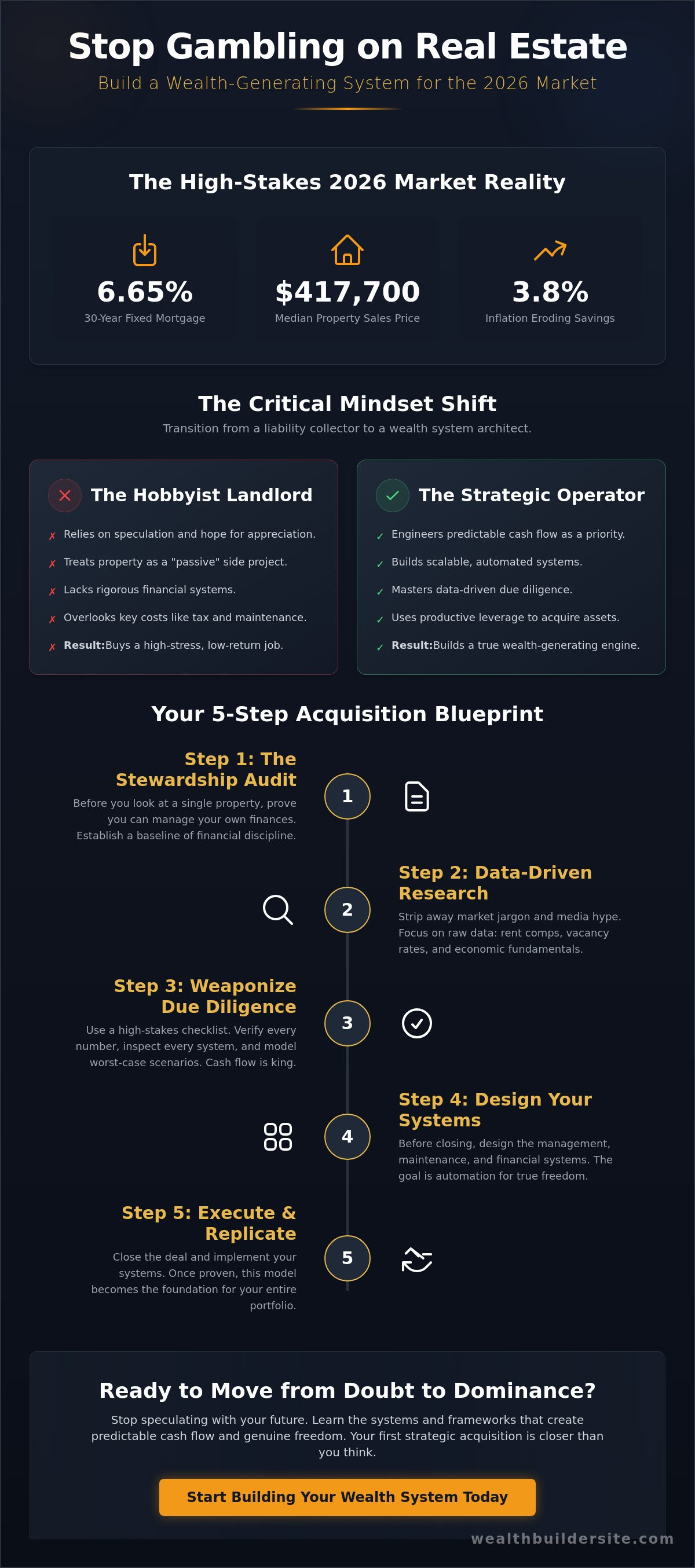
What if the traditional dream of owning a few rentals is actually a trap designed to keep you working until you're eighty? If you're still treating real estate like a side project rather than a rigorous financial engine, you're gambling with your future in a market where the median sales price has hit $417,700. You feel the pressure of the 3.8% inflation rate and the 6.65% mortgage reality; it's overwhelming. This property investment guide is your wake-up call to stop speculating and start operating like a strategic insider who understands that systems, not just houses, create freedom.
You likely agree that the fear of a bad financial decision is the only thing standing between you and the legacy you want to build. If you keep waiting for the perfect moment while rates stay above 6%, then you'll simply watch your potential wealth evaporate. I promise to show you how to build a high-performance business system that delivers predictable cash flow and scales without adding more work to your plate. We'll preview the roadmap to your first acquisition and the frameworks taught in our WealthBuilders Coaching to move you from a state of doubt to a state of total market readiness.
Key Takeaways
- Transform your approach from a casual landlord to a high-level business operator by treating every property as a strategic system rather than a passive hobby.
- Execute a "stewardship baseline" audit to determine if you possess the financial discipline required to survive and scale in the 2026 market.
- Discover why cash flow is the non-negotiable oxygen of your portfolio in this property investment guide, ensuring your business remains solvent during economic rebalancing.
- Weaponize your due diligence process with a high-stakes checklist designed to strip away market jargon and uncover the true data-backed value of an asset.
- Shift your focus from individual deeds to automated systems to ensure your investments provide genuine freedom instead of just another full-time job.
Stop Dreaming: Why Your Property "Hobby" is a Financial Liability
Are you an investor or just a collector of expensive liabilities? Most people treat real estate like a high-interest savings account that happens to have a roof. This is a lethal misconception. In a 2026 market where the national 30-year fixed mortgage rate sits at 6.65%, the margin for error has vanished. If you approach this like a hobby, you're essentially gambling with your net worth while inflation at 3.8% eats your purchasing power. A real property investment guide doesn't promise "set it and forget it" riches. It demands you build a business system designed to survive economic volatility.
Passive income is a misnomer that leads to stagnation. If you aren't actively managing your resources through the lens of stewardship, you aren't investing; you're just waiting for a disaster to happen. Real estate requires a comprehensive overview of real estate investing strategies to understand that your property is an active entity. It requires maintenance, tenant management, and constant financial optimization. If you ignore these systems, your asset quickly becomes a drain on your time and capital. Stewardship is about managing what you've been given for maximum impact, not just hoping for the best.
The High Cost of Speculation
Speculation is the silent killer of wealth. Many beginners buy properties based on the hope that prices will continue to climb, ignoring the reality that median sales prices reached a record $417,700 in April 2026. This reliance on appreciation is a gamble, not a strategy. When you prioritize cash flow, you ensure the property pays for itself regardless of market swings. Rookie mistakes, such as over-leveraging or failing to account for the 0.99% average property tax rate, lead directly to foreclosure. Property speculation is a debt-trap for the unprepared.
Property as a Wealth-Building System
The WealthBuilder mindset focuses on systems over sweat equity. You don't want to buy a second job; you want to build a machine that generates predictable wealth. Your first property is the foundation of this entire structure. It's the proof of concept for your business model. If you get the system right once, you can replicate it infinitely. Scaling requires a shift from doing the work to managing the framework. You can find that strategic roadmap at WealthBuilders University, where we strip away the fluff and focus on measurable outcomes. This property investment guide is only the beginning of that transformation.
The WealthBuilder Audit: Are You Ready to Compete?
Do you actually have the financial discipline to lead a business, or are you just looking for a shortcut to wealth? If your personal balance sheet is a mess, then adding real estate won't save you; it will only accelerate your collapse. Before you consult a single property investment guide, you must perform a cold, hard audit of your current standing. This isn't about having a perfect credit score. It's about establishing a "stewardship baseline"—a proof of concept that you can manage small resources before the market trusts you with millions. If you can't manage your own household budget, why should you be trusted with a $417,700 asset?
Debt is often framed as a monster to be feared, but for the strategic insider, it's a tool to be mastered. You must distinguish between destructive leverage, like high-interest consumer debt, and productive leverage that acquires income-producing assets. Deciding between an appreciation or cash flow investment is a tactical choice that comes only after you've proven you can handle the responsibility of a 6.65% mortgage. To master these fundamentals before you sign a deed, joining our WealthBuilders University provides the exact framework for this level of financial stewardship.
Quantifying Your Financial Runway
Lenders in 2026 have tightened their requirements. You need to calculate your true Debt-to-Income (DTI) ratio, accounting for the 3.8% inflation rate currently squeezing your margins. Before looking at listings, determine your "Risk Threshold." This is the exact dollar amount you can lose without ending up on the street. You must also build a "War Chest"—a liquid reserve for unexpected repairs. If you don't have at least six months of expenses set aside, you aren't ready to compete; you're just ready to fail.
The Mental Framework of an Investor
Emotional attachment is the quickest way to lose money in real estate. If you're buying a property because you "like the kitchen," you've already lost. An insider looks at a property as a set of numbers and systems; an outsider looks at it as a house. You need to establish your investment "Why" today. Is it for legacy, cash flow, or time freedom? Without a clear objective, you'll fold the moment mortgage rates show volatility or a tenant misses a payment. Stay focused on the data, not the drama.
Cash Flow vs. Appreciation: Choosing Your Combat Strategy
Are you playing for a quick win or long-term survival? In the 2026 market, the distinction between cash flow and appreciation is the difference between a sustainable business and a high-stakes gamble. If you rely solely on the market to lift your property's value while 3.8% inflation erodes your margins, you're a speculator, not an investor. This property investment guide isn't about hoping for the best; it's about choosing the tactical framework that aligns with your capital and your timeline for freedom. You need to decide today: are you building an ATM or waiting for a lottery win?
Cash flow is the oxygen of your business system. It provides the liquidity to handle a 6.65% mortgage rate and the 0.99% effective property tax rate without breaking a sweat. While many beginners get distracted by the shiny promise of a massive payday, seasoned insiders prioritize monthly income. You can explore various real estate investment strategies to see how these models differ, but remember that cash flow is what allows you to quit your job. Appreciation is just the icing on a cake you might never get to eat if the market cools.
The Cash Flow Model: Your Path to Freedom
If your goal is to exit the 9-to-5 grind, Net Operating Income (NOI) is the only metric that matters. This is your total income minus all operating expenses, excluding debt service. In 2026, hitting the "Rule of 1%"—where monthly rent equals 1% of the purchase price—is a challenge with a $417,700 median home price, but it remains the gold standard for safety. Cash flow provides a buffer against volatility. If the market dips, you don't care because the rent checks still clear and your debt is being paid by someone else.
The Appreciation Play: High Risk, High Reward
The "Fix and Flip" model is enticing, but it's dangerous in a cooling market where active inventory is up 4.2% year-over-year. Buyers are more cautious, and sellers are already pricing homes more realistically to avoid stagnant listings. To succeed here, you must identify "path of progress" markers, such as new infrastructure or major corporate relocations. Don't fall for the "Greater Fool" theory; if your only plan for profit is finding someone more desperate than you to buy the property later, you've already lost the game. Precision is your only protection against a debt-trap.
To master these strategies and move beyond the basics, attending our Real Estate Workshop is the next logical step for any serious professional. We move past theory and into the hard data of the 2026 market.
The 2026 Property Acquisition Checklist: From Research to Closing
If you enter a negotiation without a rigorous, data-backed framework, you've already handed your profit to the seller. Most amateur investors treat a property investment guide like a suggestion; for the WealthBuilder, it's a tactical mission plan. In a market with 1.23 million active listings, the challenge isn't finding a house. The challenge is filtering out the 99% of properties that will anchor you to mediocrity. If you skip a single step in this checklist, you aren't investing; you're just hoping for a miracle in a high-interest era.
Phase 1: Strategic Market Intelligence
- Identify "Recession-Proof" neighborhoods: Use data tools to find areas where demand outstrips the national 4.2% inventory growth.
- Analyze local job growth: Look for infrastructure projects that signal long-term stability, not just temporary hype.
- Verify zoning and STR regulations: If you don't know the local short-term rental laws, your income could be shut down by a single city council vote.
Phase 2: The Deep-Dive Due Diligence
This is where the game is won or lost. Follow the "100-to-10-to-1" rule: filter 100 properties, analyze 10, and offer on one. You must conduct a "Stress Test" on your pro-forma numbers. If your deal collapses because mortgage rates tick up from 6.65% or inflation stays at 3.8%, it's not a deal. Professional inspections are non-negotiable; skipping this is financial suicide. You are looking for structural integrity and energy efficiency, which are critical for remote management success in 2026.
Phase 3: Tactical Financing and Closing
In 2026, a "Pre-Qualification" letter is worthless. You need a full "Pre-Approval" to be taken seriously by sellers who are pricing homes at a record median of $417,700. Review the "Closing Disclosure" line by line for hidden fees that erode your initial ROI. You can't do this alone. You need a team of specialists who have already decoded this market. If you want expert oversight during this high-stakes phase, our WealthBuilders Coaching provides the elite framework you need to close with confidence.
Beyond the First Deed: Systemising Your Portfolio for Freedom
Are you an executive or a handyman? If you're still the one answering tenant phone calls at midnight or chasing down rent checks, you haven't built an investment; you've just bought yourself a low-paying second job. True wealth isn't found in the physical deed itself but in the systems that manage it. This final stage of our property investment guide focuses on the high-stakes transition from a single acquisition to a scalable enterprise. In a market where the median sales price has reached $417,700, your ability to scale depends entirely on how much of your time you can claw back through automation. If you don't build a machine that runs without you, then you'll eventually hit a ceiling that no amount of effort can break.
The 2026 landscape demands a move away from passive information toward active, systemic growth. While competitors treat property management as an afterthought, we recognize it as the core engine of your business. If your systems are weak, your profits will be devoured by the current 3.8% inflation rate and operational friction. You must stop thinking about "owning houses" and start thinking about "owning a business that happens to hold real estate." This shift in perspective is what separates the elite professional from the overwhelmed amateur.
Automating the Tenant Experience
Systematizing the tenant experience is the only way to protect your margins. By 2026, using digital tools for rent collection and automated maintenance requests isn't a luxury; it's the baseline for survival. You must vet property managers with the same rigor you used for your initial due diligence. Look for firms that use data-driven proptech to minimize vacancies as national inventory rises by 4.2%. Automation is the moat that protects your wealth from the erosion of operational inefficiency.
Scaling to Your Next Acquisition
Once your first system is profitable, it's time to trigger the snowball effect. With 100% bonus depreciation now a permanent fixture for property acquired after January 2025, your tax strategy becomes a primary engine for growth. You can also utilize the 23% Qualified Business Income (QBI) deduction to keep more capital in your system for the next down payment. If you've built a high-performance business, you can eventually leverage the equity in your first asset to fund the second. This isn't just about more houses; it's about more freedom. Surround yourself with a community of like-minded WealthBuilders who refuse to settle for a hobbyist's results. Your journey toward total financial freedom is no longer a dream; it's a logical outcome of the system you've built.
Claim Your Future: Build the Machine That Delivers Freedom
Are you ready to stop gambling on real estate and start operating like a strategic insider? If you continue to treat your portfolio as a side project, you'll remain a slave to market volatility and inflation. This property investment guide has shown you that wealth isn't an accident; it's the result of a rigorous business system. You now understand that cash flow is the non-negotiable oxygen of your enterprise and that true freedom only comes when you replace sweat equity with automation.
The choice is yours. You can walk away with this information and do nothing; or you can join a community of leaders who are already decoding the 2026 market. If you want access to proven Kingdom-driven wealth strategies and elite coaching, it's time to take the next logical step. Join WealthBuilders University and Master the Systems of Wealth to secure your step-by-step business automation tools. You have the roadmap. Now, you simply need the courage to drive. Your legacy is waiting for you to lead it.
Frequently Asked Questions
Is property investment still a safe bet in 2026 with high interest rates?
Yes, provided you stop speculating and start operating with a cash flow first mindset. Real estate remains a powerful hedge against the current 3.8% inflation rate. While 6.65% mortgage rates are higher than the historical lows of the early 2020s, they represent a rebalancing market where only those with rigorous systems survive. If your numbers work at 7%, they'll work at 6%. Don't wait for rates to drop; build a system that thrives regardless of the Federal Reserve's decisions.
How much money do I really need to start my first property investment?
You typically need 20% to 25% of the purchase price for a down payment on an investment property, plus a liquid reserve for unexpected repairs. With the median sales price hitting a record $417,700 in April 2026, a standard entry requires roughly $83,000 to $104,000 in capital. If you don't have this liquidity, you aren't ready to compete. You must establish financial stewardship before taking on the high stakes risk of leverage.
Should I buy my first investment property in my own name or an LLC?
Using an LLC is the standard for professional investors who prioritize asset protection and tax efficiency. An LLC separates your personal liabilities from your business assets, which is critical in a litigious market. Additionally, pass-through entities can take advantage of the permanent 23% Qualified Business Income deduction. You should consult a legal professional to ensure your structure aligns with your specific scaling goals and protects your lasting wealth.
What is the "1% Rule" in real estate and does it still work today?
The 1% Rule suggests that monthly rent should equal at least 1% of the property's purchase price to ensure positive cash flow. In 2026, hitting this metric is increasingly difficult in high demand markets where prices are at record highs. This property investment guide emphasizes that while the rule is a helpful filter, you must perform a full stress test on your Net Operating Income to account for the 0.99% effective property tax rate. If the 1% Rule doesn't fit, your system must find value elsewhere.
Can I invest in property if I have a full-time job and no experience?
You can, but only if you commit to becoming a business operator rather than a hobbyist. Most successful investors start while working a 9-to-5 by leveraging automation and professional property management. Experience is gained through education and frameworks, not by making expensive mistakes on your own. If you don't have time to manage the property, you must have the system to manage the manager. Stop using your job as an excuse for stagnation.
How do I find "off-market" deals that other investors are missing?
Off-market deals are found through direct-to-seller marketing and building a network of strategic insiders like wholesalers and probate attorneys. You won't find elite returns on public listing sites where active inventory is already up 4.2% year-over-year. Success requires a tactical approach to lead generation. If you wait for a deal to appear on your screen, you're already competing with thousands of others for the same scraps. You must be the one who finds the value before the market sees it.
What is the difference between a REIT and direct property ownership?
Direct ownership gives you total control and significant tax advantages like 100% bonus depreciation, whereas a REIT is a passive security. Direct ownership allows you to build a business system that you can scale and leverage for significant achievement. A REIT is essentially a dividend-paying stock that lacks the high-stakes growth potential of physical deeds. If you want true financial freedom, you need the control and measurable progress that comes with direct ownership.
How often should I review my property investment portfolio for performance?
You should perform a deep-dive audit of your portfolio's financial health every quarter. This ensures your systems are keeping pace with the 3.8% inflation rate and that your property managers are hitting their performance indicators. A monthly check of your cash flow statements is the baseline for staying solvent in this property investment guide. If you aren't measuring your metrics, you aren't managing a business; you're just hoping for luck. Precision is your only protection against falling behind.