
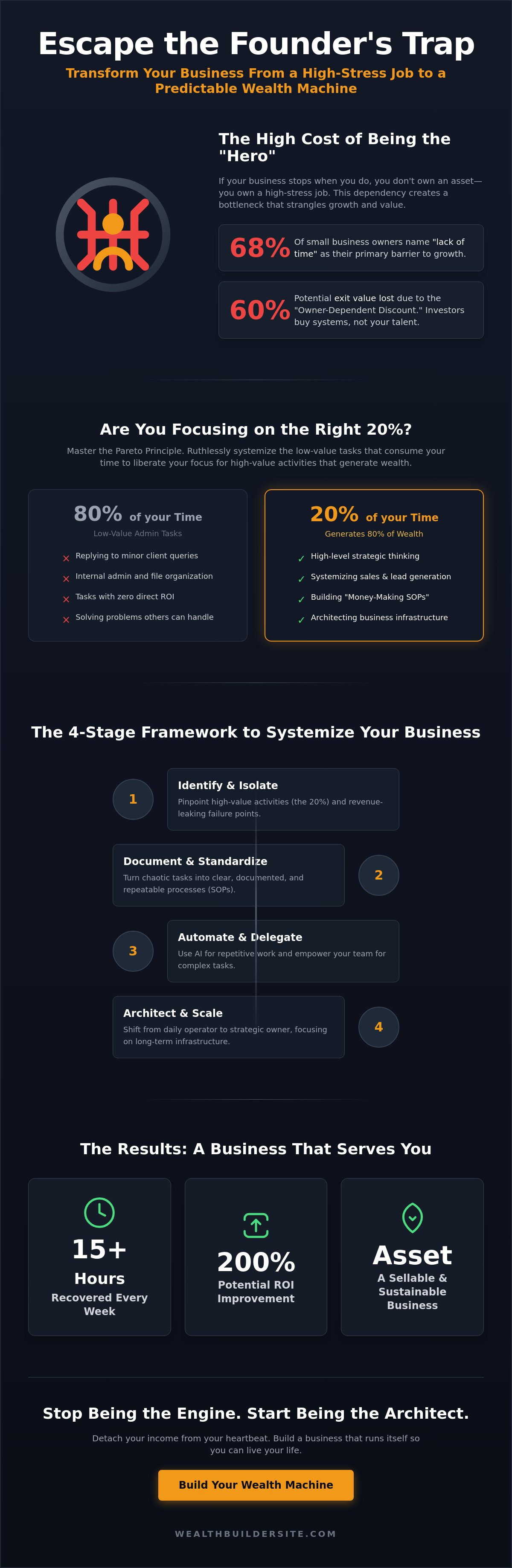
What if your business is actually just a high-stakes trap where you happen to be the most exhausted employee? If you're still the only person who can solve every crisis, you don't own an asset; you own a job that refuses to let you sleep. Most entrepreneurs believe their personal touch is the secret sauce, yet 68% of small business owners admit that a lack of time is their primary barrier to growth. Learning how to systemize a small business is the only way to stop trading your life for a paycheck. It is the strategic move that separates the elite players from the spectators in the 2026 market.
You likely feel that quality will drop the moment you look away. We agree that inconsistent results are a threat to your reputation, but the solution isn't more of your personal hours. This article provides the exact framework to transform your daily chaos into a predictable wealth machine. We will show you how to recover up to 15 hours every week while driving ROI improvements of up to 200%. You are about to discover the 2026 strategy for documenting workflows and leveraging AI-powered automation to build a business that is finally sellable, sustainable, and free of your constant intervention.
Key Takeaways
- Escape the "Founder Trap" by identifying the hidden liabilities of being the only problem-solver in your company.
- Isolate the high-value activities that generate 80% of your wealth and ruthlessly systemize the low-value admin tasks.
- Implement a 4-stage framework on how to systemize a small business that turns chaotic tasks into documented, repeatable assets.
- Master the distinction between AI-powered automation and human delegation to scale your operations without adding personal stress.
- Shift your identity from a daily operator to a strategic architect by establishing a "CEO Day" dedicated to building long-term infrastructure.
The Invisible Cost of Being the Hero: Why Your Business is Actually a High-Stress Job
Are you the most important person in your company? If you just answered "yes" with a sense of pride, you've already lost the game. This is the Founder Trap. It's a state of perpetual motion where every decision, from high-level strategy to minor client queries, requires your signature. If you aren't there to answer the phone, the gears stop turning. That isn't a business; it's a high-stress job where you happen to be both the employer and the most exploited employee. If your physical presence is the only thing keeping the lights on, you don't own an asset. You own a cage.
Many entrepreneurs wear their "hero" status as a badge of honor. They believe they're protecting the business by being involved in everything. In reality, being the hero is a selfish act. It stunts your team's growth, breeds employee inconsistency, and ensures that your company can never scale beyond your personal stamina. When you refuse to document how to systemize a small business, you're telling your team that they aren't capable of excellence without your shadow hanging over them. You aren't saving the day; you're creating a bottleneck that strangles your cash flow velocity.
The Math of the Bottleneck
Decision fatigue is a silent tax on your net worth. As of June 2026, market data shows that owner-dependent businesses suffer from a massive valuation discount. Investors don't want to buy your personal talent. They want to buy a predictable machine. If you are the primary driver of results, your business is effectively unsellable. Every time a process stops to wait for your approval, your revenue slows down. This "Owner-Dependent Discount" can slash your company’s potential exit value by 40% to 60%. If the business can't run without you, it isn't worth much to anyone else.
Systems as the Ultimate Wealth Protection
Systems are not just clerical checklists. They are the insurance policy for your freedom. By implementing a rigorous business process management strategy, you detach your income from your heartbeat. This is the only path to true wealth. A systemized business is a sellable asset because it proves that results are the product of the process, not the person. When you integrate the right business automation software, you stop being the engine and start being the architect. You move from a state of constant interruption to a state of predictable growth. If you want to stop trading time for money, you must stop being the solution to every problem.
Identifying the 20% of Work That Generates 80% of Your Wealth
Stop pretending that every email in your inbox has equal value. If you spend your afternoon on $20-an-hour admin tasks, you are effectively paying yourself $20 an hour. This is the death of an entrepreneur. To master how to systemize a small business, you must first apply the Pareto Principle with cold, surgical precision. Are you spending 80% of your energy on the "Necessary Evil" tasks that keep the lights on, or are you focused on the 20% of high-value activities that actually drive your wealth? If your daily schedule is a graveyard of low-impact chores, you aren't building a legacy; you're just managing a decline.
Most owners fail because they try to systemize everything at once. They create elaborate manuals for the breakroom cleaning schedule while their lead generation remains a chaotic mess. You must map your customer journey to find the critical failure points where revenue leaks out. Use the "Stop, Start, Continue" framework to audit your current workflows. Stop doing tasks that offer zero ROI. Start documenting the processes that move the needle. Continue the high-level strategic thinking that only you can provide. To truly Systemize Your Systems, you must prioritize the infrastructure that protects your time and your profit margins.
The Revenue-First Systemization Strategy
Wealth is built through sales and delivery, not file organization. You should systemize your sales and lead generation pipelines before you ever touch HR or internal admin. These "Money-Making SOPs" ensure that your revenue is predictable rather than accidental. If your income depends on your personal mood or a lucky referral, you are at risk. A Critical Success Factor is a non-negotiable step in your workflow that, if missed, directly results in a loss of revenue or a failed client outcome. Focus your energy here first. If you're ready to stop guessing and start scaling, our Business Workshop provides the tactical blueprints to secure these revenue streams.
Audit Your Time: The Freedom Log
You cannot fix what you do not measure. For the next 7 days, track your time in 15-minute increments to identify recurring low-value tasks. This "Freedom Log" will reveal exactly where your life is being stolen. Once you have the data, categorize every task into three buckets: Delegate, Automate, or Eliminate. If a task doesn't require your unique genius, it is a liability. Spotting these system leaks is the first step toward reclaiming 8 to 15 hours per week. By removing yourself as the primary operator of these tasks, you create the space necessary to function as the architect of your own wealth.
The 4-Stage Framework for Business Systemization
If you think systemization starts with a 50-page manual, you're living in the past. Most entrepreneurs drown in the "what" of documentation but never master the "how." They buy expensive software before they have a functional process. The reality is simple: if you can't hand a task to a non-expert and get a perfect result without saying a word, your system is broken. Learning how to systemize a small business isn't about clerical busywork. It's about building a framework that survives your absence. We use a 4-stage protocol designed for speed and surgical precision.
- Stage 1: Capture. Stop writing. Start recording. Use screen capture or voice notes to document work as it happens in real-time.
- Stage 2: Document. Convert those raw captures into lean, visual Standard Operating Procedures (SOPs). If it's longer than two pages, nobody will read it.
- Stage 3: Test. This is the stress test. Hand the SOP to someone who has never done the task. If they have to ask you a single question, the system failed.
- Stage 4: Optimize. Systems are living assets. Use feedback loops to refine your processes for 2026 efficiency, ensuring they evolve with your market.
The "Loom and Notion" Capture Method
Writing a first draft of an SOP is a waste of your strategic time. Video is 10x faster and captures the nuances that text misses. Record yourself doing the task once, then use AI tools to transcribe and summarize the video into a clear checklist. Store these in a centralized internal knowledge base. This creates a single source of truth that stays organized as you scale. If your team has to hunt for information, you're still paying a "chaos tax" on every hour they work. Consistency is the only way to protect your reputation and your profit margins.
The Stress Test: Delegating the "How"
True freedom comes from the "No-Questions" Rule. If an employee interrupts your day to ask how to perform a documented task, do not give them the answer. Direct them back to the system. If the answer isn't there, the system is the problem, not the person. Your job is to provide feedback on the process without taking the task back onto your own plate. This builds a culture where the team is responsible for the architecture of the business, not just the execution. If you want a business that runs without you, you must stop being the person with all the answers. If you're ready to build this infrastructure, our WealthBuilders University provides the exact frameworks to move from operator to architect.
Automation vs. Delegation: Choosing the Right Lever for Scale
Are you still paying a human salary for a task that a $20 script can handle? If so, you are burning capital. Mastering how to systemize a small business requires you to stop viewing every operational bottleneck as a human problem. In the 2026 market, the most successful architects of wealth follow a strict "Automation First" rule. If a software can execute the logic, you never hire a person for the role. Automation is your digital workforce. It consists of Zapier integrations, AI agents, and CRM workflows that never get sick, never ask for a raise, and never suffer from decision fatigue. When you implement these tools, you can expect to recover 8 to 15 hours per week while improving your response speed by 25%.
Delegation is the second lever. It involves human capital. You delegate nuance, creativity, and high-level strategy to virtual assistants, managers, and specialists. If you confuse these two levers, you end up with a bloated payroll and a system that still breaks. High-level decisions regarding your infrastructure often require specialized business coaching to ensure you aren't just building a more expensive version of your current bottleneck. If you're struggling to identify which lever to pull first, our WealthBuilders Coaching provides the strategic oversight you need to make these calls with confidence.
Building Your Tech Stack for 2026
Your tech stack is the central nervous system of your business. In 2026, entry-level marketing automation can range from free to approximately $350 per month. This is a fraction of the cost of a part-time employee. Focus on three essential categories: a robust CRM, agile Project Management, and Financial Automation. Avoid the "All-in-One" trap. These platforms often trade depth for convenience, leaving you with a suite of mediocre tools that can't handle complex scaling. Use AI to automate customer service and data entry with 100% precision, allowing your human team to focus on revenue-generating activities.
High-Level Delegation: Hiring for Ownership
When you finally decide to hire, stop looking for "task-doers." You need "process-owners." A task-doer waits for instructions, which keeps you in the Founder Trap. A process-owner manages the system itself. To ensure accountability, create a "Scorecard" for every role. This isn't a vague job description; it's a list of measurable outcomes and system adherence metrics. Whether your team is remote or hybrid, their performance should be judged by the data, not by how busy they look. If the system is documented and the scorecard is clear, the business runs without your constant intervention. This is how to systemize a small business for a future exit.
From Operator to Owner: Implementing Your Wealth-Building Infrastructure
If you are still the smartest person in the room, you are in a dangerous position. Your ego is currently the greatest threat to your net worth. To truly understand how to systemize a small business, you must commit to a total identity shift. You are no longer the "Expert" who solves every crisis; you are the "Architect" who designs the machine that solves them for you. This requires a structural commitment to a "CEO Day." This is a non-negotiable block of time where you work exclusively ON the business. If you spend this time answering emails or putting out fires, you have already failed the week.
Letting go is not a sign of weakness; it is a strategic necessity. Most founders suffer from a pathological need for control, fearing that quality will drop the moment they step back. But if your quality depends on your constant intervention, your business is a fragile house of cards. Systemization is the process of de-risking your life. By detaching your income from your hours, you transform your company from a high-stress job into a sellable asset. This is how you position yourself for maximum wealth creation in the 2026 market. Stop pretending your presence is a benefit when it is actually a bottleneck.
The First 30 Days: A Practical Implementation Timeline
- Week 1: The Audit. Conduct the time audit. Identify your top three bottlenecks. These are the tasks that "only you" can do.
- Weeks 2-3: The Capture Phase. Use the video capture method to document the first five critical SOPs for those bottlenecks. Don't aim for perfection; aim for clarity.
- Week 4: The Hands-Off Test. Choose one full day to be completely unreachable. If the business breaks, you've found your next systemization target.
Scaling Beyond the Business
Your business should be the engine that funds your legacy, not the weight that drags you down. When your operations are systemized, the resulting cash flow can be diverted into high-yield assets. This is the bridge to attending advanced real estate workshops and building a portfolio that grows while you sleep. True Money Mastery is only possible when your time is no longer a commodity you sell to your own company. If you are ready to stop being an employee of your own ambition, join WealthBuilders University today to get the full blueprint for freedom. The market doesn't reward hard work; it rewards the systems that produce results.
The Architect's Exit: Securing Your Freedom in 2026
Will you be the architect of your freedom or the janitor of your own ambition? The choice is made every time you decide whether to solve a problem personally or build a system that solves it forever. You've seen the 4-stage framework and the 2026 tech stack. You know that every hour you spend on low-value tasks is a tax on your future wealth. Mastering how to systemize a small business is the only way to transform a high-stress job into a self-sustaining asset that provides true time freedom. If you aren't building a machine that runs without you, you aren't building a business at all.
The market doesn't reward those who work the hardest; it rewards those who build the best machines. If you're ready to stop being the bottleneck, you need a blueprint backed by data and results. Led by strategic insider Billy Epperhart, our proven frameworks focus on the latest AI integration and automation strategies to de-risk your life. Don't let another year pass as an employee of your own company. It's time to claim the predictable growth and sellable value you deserve. Your legacy is waiting for you to step out of the way.
Stop Being the Bottleneck and Join WealthBuilders University Today
Frequently Asked Questions
How do I start systemizing my business if I have zero spare time?
You start by documenting your actions in real-time rather than setting aside extra hours. If you have no spare time, it's because you are currently trapped in a bottleneck of your own making. Use screen recording tools or voice notes to capture a task while you are actually doing it. This "capture as you go" method builds your library of assets without requiring a single minute of overtime. It is the only way to begin extracting yourself from the daily grind.
What is the best software for documenting small business systems in 2026?
The gold standard for 2026 is a combination of video capture tools and a centralized knowledge base with AI transcription capabilities. Use tools that allow you to record a process once and automatically generate a written checklist from your actions. This creates a single source of truth for your team. Avoid complex, all-in-one platforms that trade depth for convenience. A lean tech stack that integrates your CRM with your project management tool is usually the most effective infrastructure for growth.
Can I systemize a service-based business that is highly customized?
Yes, you must systemize the repeatable 80% to protect the headspace needed for the custom 20%. Even the most bespoke services rely on standard onboarding, invoicing, and reporting workflows. If you don't automate these routine elements, your "custom" work will eventually suffer from inconsistent quality and founder burnout. Systemization doesn't kill creativity; it provides the operational security that allows your unique genius to actually scale.
How do I get my employees to actually use the SOPs I create?
You make system adherence a non-negotiable metric on every employee's performance scorecard. If a team member asks a question that is clearly answered in the documentation, you must refuse to provide the answer and instead direct them to the SOP. This "No-Questions" Rule reinforces the system as the ultimate authority in the company. When you stop being the person with all the answers, your team will finally start looking at the blueprints you've built.
Is it better to hire a virtual assistant or use automation software first?
You should always prioritize automation software over human capital. Never hire a person to perform a task that a $20 per month script or an AI agent can execute with 100% precision. Automation doesn't need a vacation and never suffers from decision fatigue. Once you've automated every possible logic-based task, you can then hire a virtual assistant to manage the remaining nuances and creativity that software cannot yet replicate.
What is the difference between a process and a system?
A process is a specific sequence of steps to achieve one result, while a system is the broader infrastructure of people, tools, and processes that run an entire department. Understanding how to systemize a small business means looking at the big picture rather than just individual tasks. A system ensures that your sales, delivery, and finance departments function as an interconnected machine. If one process fails, a robust system has the feedback loops necessary to identify and fix the leak immediately.
How often should small business systems be updated?
Systems should be audited quarterly to ensure they still reflect the most efficient way to achieve a result. In the fast-paced 2026 market, a stagnant system is a liability that will eventually lead to lower profit margins. You should assign "process owners" within your team who are responsible for updating documentation whenever a new tool or AI capability is integrated. If a system hasn't been touched in six months, it's likely obsolete.
Will systemizing my business make it feel impersonal to my customers?
No, it actually creates a superior experience by ensuring your customers receive the same high-quality result every single time. When you systemize the routine administrative work, your team is no longer stressed or overwhelmed by low-value tasks. This frees them up to provide genuine, high-level human connection at the most critical touchpoints. Consistency is the highest form of customer service, and it's impossible to achieve without a documented framework.